

Borno State Governor, Professor Babagana Umara Zulum, has called on the Federal Government to reframe its approach to power supply in Nigeria by prioritizing equitable access to electricity, especially for vulnerable and low-income populations.
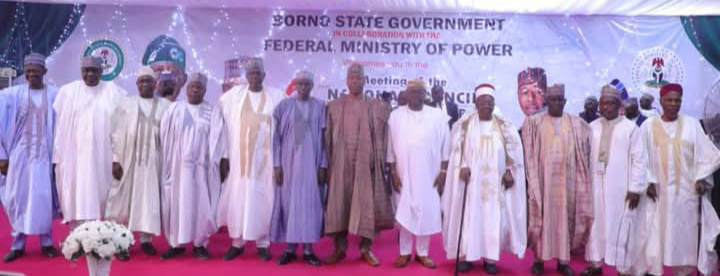
Governor Zulum made the call during the opening of the 6th National Council on Power (NACOP) held in Maiduguri, the Borno State capital, where he addressed key stakeholders, including the Minister of Power, Chief Adebayo Adelabu.
“Electricity is not just about wires and transformers it’s about dignity, economic opportunity, health, education, and the right of every child to dream,” Zulum said. “We must view energy not just as a commodity but as a social service.”
While clarifying that he does not advocate for an across-the-board subsidy, the governor urged the Federal Government to implement targeted subsidies to support vulnerable communities who may be unable to afford rising energy costs.
Zulum expressed appreciation to Minister Adelabu for his leadership and responsiveness, and he commended President Bola Ahmed Tinubu for sustained federal interventions in Borno’s power infrastructure.
Highlighting progress made under the current administration, the governor listed several completed and ongoing power projects in the state, including:a 7.5MVA substation at the University of Maiduguri, rehabilitation of 132/33kV substations, anew substation at the College of Agriculture, Damboa, and a1x32.5MVA transmission station in Bama.
In response, Minister Adebayo Adelabu acknowledged Borno’s resilience and commitment to collaboration, despite the unique security and infrastructure challenges the state faces.
“Let me begin by expressing our profound gratitude to His Excellency, Governor Zulum, and the good people of Borno for hosting this important gathering,” Adelabu said. “The warmth and generosity extended to delegates from across the country are deeply appreciated.”
Governor Zulum also announced that the Borno State Government is actively aligning with the Federal Government’s national power reforms, with a focus on decentralized and sustainable energy solutions.
He noted that Borno has expanded off-grid solutions, launched pilot energy projects, and partnered with the Transmission Company of Nigeria (TCN) to improve grid stability.
“Our administration has invested over ₦1.5 billion in critical electrical components, with significant support from the Federal Government,” Zulum revealed. “We have also provided security and logistics to protect transmission infrastructure.”
According to the governor, electrification efforts have reached some of the most difficult and conflict-affected areas, including: Maiduguri-Gubio-Damasak transmission corridor, power extension to Konduga, Bama, and Banki, electrification of Damboa, Gwoza, and Kwaya Kusar, and power reinforcement in remote communities like Marte, Abadam, and Kukawa
The summit, as observed by WorldClass247News, brought together stakeholders from across the nation to deliberate on advancing Nigeria’s power sector, with a special focus on accessibility, reform implementation, and sustainable infrastructure.