

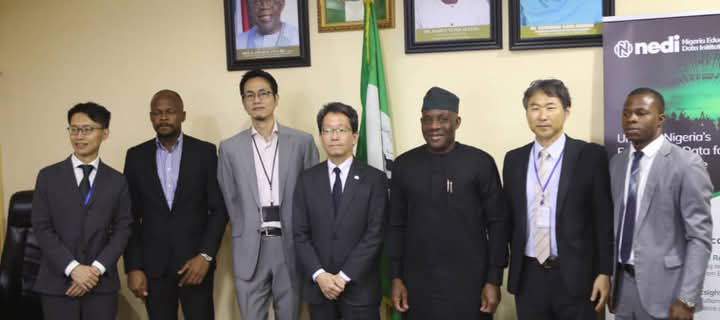
The Federal Government has called for greater alignment of education projects with national priorities to tackle Nigeria’s educational challenges effectively.
The Minister of Education, Dr. Maruf Olatunji Alausa, made the appeal during a meeting with representatives of the Japan International Cooperation Agency (JICA).
Dr. Alausa emphasized the need for collaboration among stakeholders, stating, “The era of working in isolation is gone. We must ensure that all interventions align with our national priorities to yield measurable results.”
He acknowledged JICA’s ongoing contributions to Nigeria’s education sector and stressed the importance of scaling up these efforts. He proposed incorporating the Universal Basic Education Commission (UBEC) to establish at least one effective school in each of the 36 states.
To enhance the initiative, Dr. Alausa recommended that teachers under the Strengthening Mathematics and Science Education (SMASE) project be trained in effective school locations to create synergy.
He announced plans for a high-level meeting in April involving JICA, UBEC, and the Ministry of Education to finalize a joint financing strategy for nationwide implementation.
JICA’s Chief Representative, Mr. Yuzurio Susumu, reaffirmed the agency’s commitment to supporting Nigeria’s education sector, highlighting JICA’s initiatives in curriculum development, ICT integration, and teacher training.
Meanwhile, JICA Nigeria’s Program Coordinator for Education, Mr. Nwanya Stephen, outlined the agency’s ongoing efforts, focusing on teacher development, social mobilization, and school infrastructure improvements.
The Federal Ministry of Education reiterated its commitment to partnering with JICA and other development agencies to drive meaningful reforms.
The upcoming April meeting is expected to serve as a crucial step toward expanding the effective school model nationwide, ensuring long-term sustainability and a lasting impact on Nigeria’s education system.