

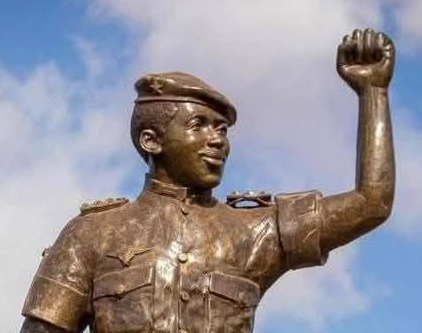
In a moment of national pride and continental reflection, Burkina Faso unveiled a towering statue of revolutionary leader Thomas Sankara on in the capital, Ouagadougou.
The ceremony, attended by thousands and led by current President Captain Ibrahim Traoré, marked a major milestone in honoring the legacy of the slain leader, often hailed as a symbol of African self-determination and resistance against imperialism.
The statue is the centerpiece of the newly inaugurated Thomas Sankara Memorial and Museum, a 14-hectare complex designed by world-renowned Burkinabe architect Francis Kéré.
The site, as observed by WorldClass247News, includes a mausoleum for Sankara and his 12 comrades assassinated with him in 1987, an 87-meter tower, an amphitheater, and open green spaces intended to foster community engagement and education.
“This is not just a statue; it is a beacon of African dignity and resistance,” Kéré declared during the event, underlining the site’s purpose as both a place of remembrance and inspiration for future generations.
Sankara, who led the country from 1983 until his assassination, is remembered for transformative policies that emphasized self-reliance, anti-corruption, and anti-imperialism. Under his leadership, the nation was renamed from Upper Volta to Burkina Faso, or “Land of Upright People.” He implemented widespread reforms in healthcare, education, agriculture, and women’s rights, earning him the nickname “Africa’s Che Guevara.”
His outspoken opposition to Western neocolonialism, especially France’s continued influence in the region, is widely believed to have played a role in the French-backed coup that ended his life at the age of 37.
President Traoré, who took power in a 2022 coup, has frequently been compared to Sankara and embraced as his ideological successor.
Like Sankara, Traoré has pursued a bold anti-imperialist agenda expelling French troops, asserting control over gold resources, and promoting traditional Burkinabe identity in national institutions.
His leadership in forming the Alliance of Sahel States (AES) alongside Mali and Niger has been hailed by supporters as a modern realization of Sankara’s dream for a united, self-reliant Africa. The AES, launched in 2023, aims to create a joint military and economic front to counter external exploitation and ensure regional stability.
International solidarity echoed across the continent as the statue was unveiled. In Kenya, Pan-African advocate Professor PLO Lumumba praised Sankara’s enduring influence: “Sankara spoke truth to power, challenging global domination while uplifting his people. His legacy is a clarion call for Africa’s awakening.”
Despite ongoing challenges, including armed insurgencies and alleged foreign-backed coup attempts, supporters believe Traoré is charting a path Sankara would be proud of. U.S. AFRICOM Commander General Michael Langley recently accused Traoré of misusing gold revenues allegations dismissed by the government and its supporters as propaganda akin to the disinformation campaigns that once targeted Sankara.
“This statue isn’t just bronze and stone—it’s our voice, our strength, our refusal to be colonized again,” said a young demonstrator at the unveiling, waving both the Burkinabe and AES flags.
As Burkina Faso stands at a political crossroads, the Thomas Sankara Memorial is expected to become a pilgrimage site for Pan-Africanists around the world. For many, it signals not only a tribute to a revolutionary past, but also a commitment to reclaiming Africa’s future.