

By Rebecca Caleb Maina
Just weeks ago, Aisha, a one-year-six-month-old girl, was on the brink of death her tiny ribs protruding, her eyes sunken, and her energy almost completely drained.
Her mother, Hurera Jibrin, had tried everything she could, feeding her whatever little food she could afford, but nothing seemed to help.
“I watched my daughter grow weaker every day. She had no energy to cry, to move, or even to look at me properly. I felt helpless,” Hurera recalled.
The Lifeline That Changed Everything
in response to the growing malnutrition crisis, the Gombe State Government, in collaboration with UNICEF, procured 5,830 cartons of Ready-to-Use Therapeutic Food (RUTF) to treat children suffering from Severe Acute Malnutrition (SAM).
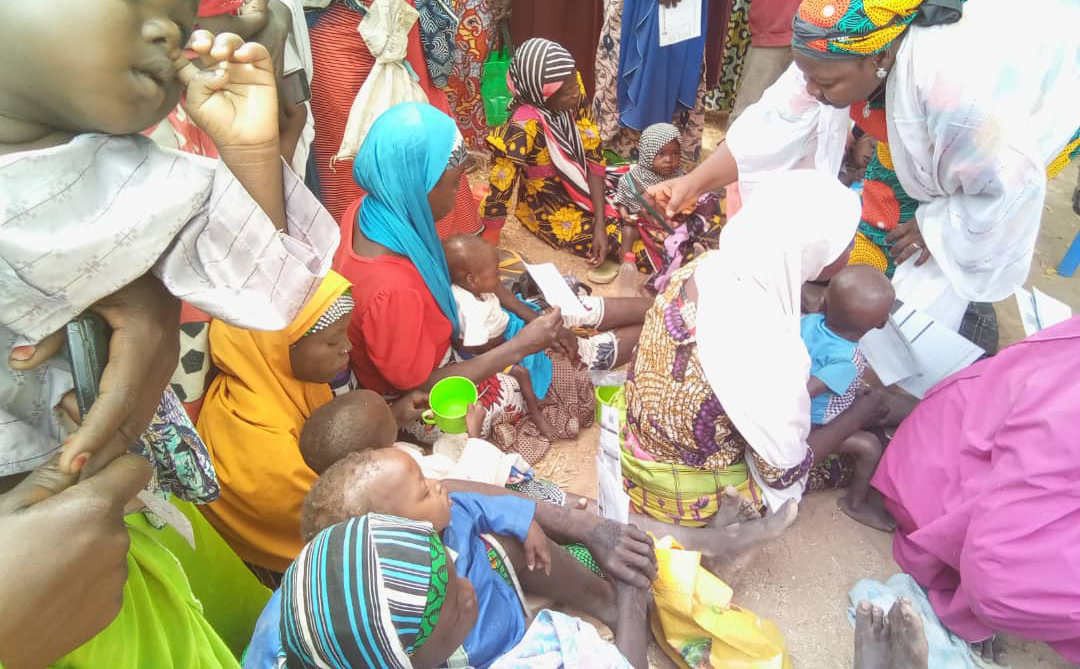
Upon arrival at the Primary Health Care Centre in Gadam, Kwami Local Government Area, health workers quickly assessed Aisha checking her weight, measuring her arm circumference, and confirming she was severely malnourished.
Aisha was immediately enrolled in the Integrated Management of Acute Malnutrition IMAM programme and given small sachets of RUTF, a nutrient-rich peanut paste designed to restore malnourished children to health.
“The instructions were simple feed her three times a day and return for check-ups. I followed them exactly because I was determined to see my daughter recover,” Hurera said.
Signs of Hope and Recovery
Days turned into weeks, and soon, Hurera noticed a remarkable change.
“Her dull eyes began to sparkle. She gained weight, her skin looked healthier, and for the first time in months, she had the strength to smile,” Hurera said, beaming with joy.
“This food saved my daughter’s life. I don’t know what I would have done without it,” she added with a grateful smile.
Hurera’s story is not unique. Across Gadam, Gombe Abba, Birin Bolawa, Malam Siddi, Dogon Ruwa, and Gombe town, mothers share similar experiences.
In Tudun Wada, Khadija Abbas had watched helplessly as her son, Yusuf, became too weak to play.
“He just lay there, staring blankly. His body was wasting away, and every passing day felt like a countdown to tragedy,” she recalled.
But after starting the RUTF treatment, Yusuf slowly regained his strength.
“He was slipping away from me, but now he laughs and runs again. I can’t express how grateful I am,” Khadija said, holding Yusuf close.
Aishatu Auwal, another mother from Gombe town, also shared her relief.
“My child had been on the RUTF programme for a few weeks, and the difference is clear,” she said.
“Before, I thought I was going to lose him. Now, he is recovering, and all I can say is thank you,” she added with a relieved smile.
Reaching More Children in Need
For Hurera Jibrin and Hadiza Omar, it was their first visit to the Primary Health Care Centres in Gombe Abba and Birin Bolawa, located in Dukku and Nafada Local Government Areas.
Their children Zarah, Hassan, and Hussaini were being examined by healthcare workers, and they were hopeful that they, too, would be enrolled in the programme. “I have heard of RUTF saving lives, and I pray it saves my children too,” Hurera said.
During a supportive supervision and monitoring visit to a CMAM centre, the Gombe State Committee on Food and Nutrition supported by UNICEF witnessed heartbreaking scenes dozens of severely malnourished children, too weak to stand, their mothers watching helplessly.
A Collective Commitment to Fighting Malnutrition
The Commissioner for Budget and Economic Planning, Alhaji Salihu Baba Alkali, reaffirmed the government’s commitment to tackling malnutrition.
“We will continue to invest in nutrition programmes because no child should die from hunger when solutions exist,” he said.
Gombe State Coordinator, Civil Society Scaling Up Nutrition in Nigeria (CSSUNN), Mrs Comfort Mukollo, also emphasised the impact of RUTF.
“We are seeing children recover, and this encourages us to keep fighting malnutrition,” she stated.
Traditional leaders, like Alhaji Yahaya Hammari, stressed the need for empowering mothers with nutrition education, promoting breastfeeding, proper weaning practices, and the use of locally available nutritious foods.
“RUTF is saving lives, but we must teach families how to prevent malnutrition in the first place,” he said.