

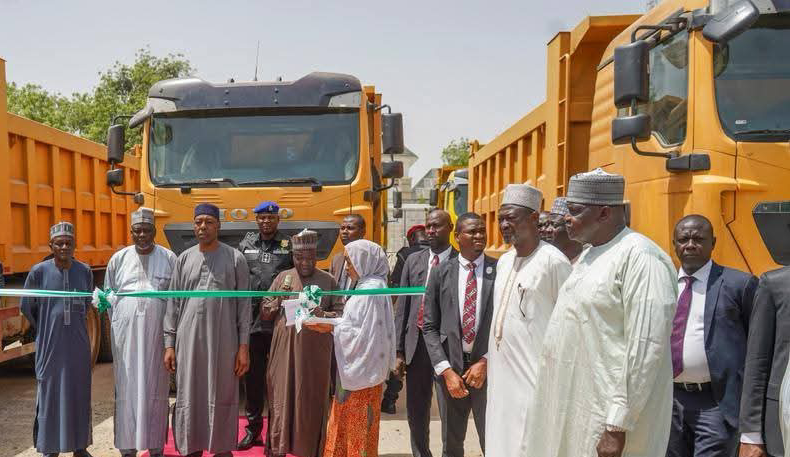
In a bold move aimed at overcoming longstanding logistical and security challenges, Borno State Governor, Babagana Umara Zulum, has unveiled a dual-pronged strategy to fast-track infrastructure development: the establishment of a quarry centre in Pulka and the deployment of 70 new utility trucks to key state agencies.
The announcement, made on Monday at the Government House in Maiduguri, highlights a shift toward self-reliance in road construction and maintenance, particularly in hard-to-reach and security-compromised areas.
At the heart of the initiative is a newly established quarry plant located in Pulka, within Gwoza Local Government Area. The facility is expected to serve as a steady source of essential construction materials such as granite, gravel, and sharp sand—resources that have often been difficult and costly to procure externally.
Governor Zulum disclosed that the quarry, built at an estimated cost of ₦3 billion, has a production capacity of 120 tons per hour. The plant is expected to significantly reduce project delays linked to material shortages while lowering the overall cost of road construction across the state.
“We have made considerable progress in sectors like health, education, agriculture, and security,” Zulum said. “However, road construction—especially in rural communities—remains a major challenge.”
Complementing the quarry project is the procurement of 70 brand-new Howo pickup trucks, distributed to the Ministry of Works and the Borno State Road Maintenance Agency. The vehicles are expected to boost field operations, enabling faster movement of materials and rapid intervention on deteriorating road networks.
This investment reflects the administration’s broader strategy of strengthening internal capacity within government agencies, rather than relying heavily on external contractors.
A key driver of this policy shift is the persistent insecurity in parts of Borno State, which continues to deter private contractors from taking on projects in high-risk areas.
“No serious contractor is willing to deploy equipment to most of the project sites under the current security situation,” the governor noted. “We have no option but to empower our institutions to deliver.”
Analysts say this approach could mark a turning point in how infrastructure projects are executed in conflict-affected regions, where reliance on private firms has proven increasingly unreliable.
By investing in both material production and operational logistics, the Zulum administration appears to be laying the groundwork for a more resilient and autonomous infrastructure system. The integration of quarry operations with an expanded transport fleet is expected to streamline project execution from sourcing to delivery.
Beyond immediate gains, the initiative may also stimulate local economic activity in Pulka and surrounding communities, potentially creating jobs and supporting small-scale industries linked to construction.
As Borno continues its recovery from years of insurgency, the success of this strategy could serve as a model for other regions grappling with similar challenges—where security concerns and infrastructure deficits intersect.