

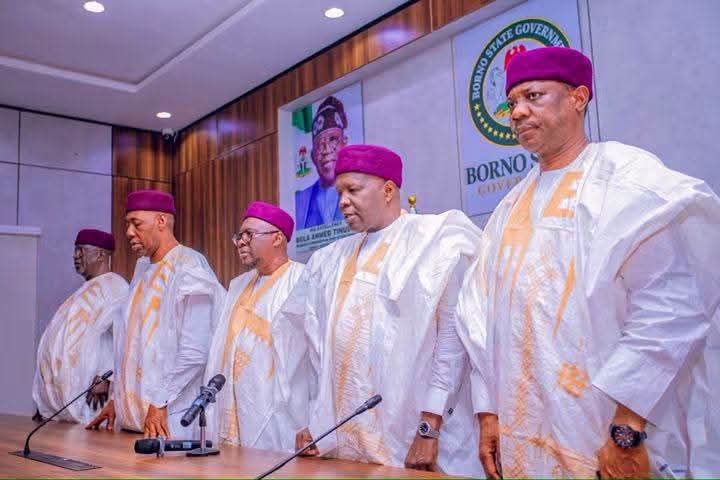
Governors of the six North-East states have called for renewed Federal Government action on stalled oil exploration, major infrastructure projects and regional economic development, as they reaffirmed their commitment to tackling insecurity and humanitarian challenges confronting the subregion.
The call was contained in a communiqué issued at the end of the 13th meeting of the North-East Governors’ Forum (NEGF), held in Maiduguri, Borno State, on Saturday.
The meeting was chaired by Borno State Governor and Chairman of the Forum, Prof. Babagana Umara Zulum, with Adamawa Governor Ahmadu Umaru Fintiri, Gombe Governor Muhammadu Inuwa Yahaya and representatives of the governors of Bauchi and Yobe states in attendance. Borno Deputy Governor Umar Usman Kadafur also participated.
The governors said the Forum had, since its inaugural meeting in Gombe in March 2020, strengthened cooperation among the six states and provided a common platform for addressing shared security, economic, social and infrastructural challenges.
The Forum specifically commended President Bola Ahmed Tinubu’s renewed attention to the Port Harcourt–Jos–Bauchi–Gombe–Maiduguri rail corridor, the Akwanga–Jos–Bauchi–Gombe–Biu–Maiduguri highway and oil exploration at the Kolmani field.
It, however, urged the Federal Government to revisit oil exploration activities that were earlier commenced but later stalled in Magumeri and Gubio Local Government Areas of Borno State.
Zulum had earlier made a similar call at the meeting, urging renewed exploration in the two Borno communities while stressing the potential of responsible resource development to support employment, infrastructure and local economies.
On power supply, the governors said their collective efforts had shifted the energy conversation from individual state concerns to a regional agenda. They noted that the Dadinkowa Hydropower Plant now feeds electricity into the national grid.
They urged member states to take advantage of the new electricity law and the region’s abundant sunshine to expand solar power and mini-grid projects, particularly in underserved communities.
The Forum also renewed its call for the Federal Government to expedite action on the Mambilla Hydropower Project, following the resolution of the legal impediment through an arbitration ruling, describing the project as important to the region’s long-term energy needs.
On education, the governors acknowledged the intervention of the North-East Development Commission (NEDC) but called for increased investment in the sector, including the release of long-awaited scholarships for indigent students and stronger interventions to reduce the number of out-of-school children.
They also advocated coordinated support for Tsangaya education as part of efforts to improve access to learning across the region.
In the transportation sector, the Forum announced plans to partner with Green Ville Energy to establish additional compressed natural gas (CNG) and liquefied natural gas (LNG) stations across the region to reduce transportation costs, improve logistics and stimulate economic activities.
The governors also welcomed Federal Government support through the NEDC for the provision of 10,000 electric tricycles, 10 electric buses and 300 electric taxis, which are scheduled for launch in October.
As part of efforts to improve regional connectivity, the Forum resolved to establish a North-East regional air shuttle to facilitate faster movement of people and goods within and between states.
On security, the governors acknowledged the gains recorded in the fight against insurgency, commending the Armed Forces and other security agencies for their sacrifices, as well as communities and governments for their resilience and support.
They nevertheless warned that the region continued to face significant humanitarian and infrastructural challenges, pledging to strengthen inter-state cooperation, intelligence sharing, community engagement and coordinated responses to emerging security threats.
The governors also linked sustainable security to economic opportunity, resolving to intensify efforts to address socio-economic conditions that could make young people vulnerable to recruitment or exploitation by criminal and extremist groups.
With the North-East having one of the youngest populations in the country, the Forum said it would prioritise quality education, vocational training, entrepreneurship, technology and employment opportunities for young people.
The governors also expressed concern over the environmental damage caused by deforestation and agreed to partner with the Institute of Forest Research to train forest experts across the region.
The Forum is scheduled to hold its next meeting on December 18 and 19, 2026, in Gombe State.
The governors’ emphasis on infrastructure, human capital and economic development mirrors broader concerns raised at the Maiduguri meeting about consolidating security gains and moving communities from humanitarian relief towards recovery and sustainable development.