

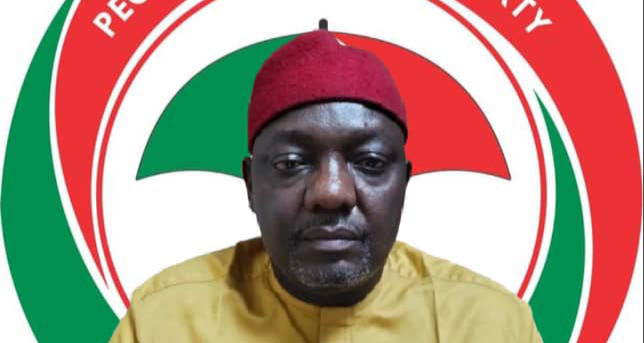
A major crisis erupted Saturday at the Peoples Democratic Party (PDP) North Central Zonal Congress in Jos as Stephen Abraham Ajiya, a leading contender for the position of National Vice Chairman (North Central), firmly rejected calls from top party leaders to withdraw from the race.
The development, at the time of filing this report, has heightened tensions within the PDP, with the congress now at the center of what appears to be a fierce internal battle for control of the party’s North Central structure ahead of the 2027 general elections.
The position in contention has been micro-zoned to the Federal Capital Territory (FCT), but behind-the-scenes maneuvering has ignited accusations of elite imposition and external interference.
Sources at the venue revealed that Ajiya was summoned to a high-level, closed-door meeting earlier in the day, where he was pressured to step aside for a preferred candidate believed to have the backing of influential figures within the party’s inner circle.
Attendees at the meeting reportedly included the Governor of Plateau State, a former Governor of Niger State, the Senate Minority Leader, multiple senators, and state PDP chairmen from across the North Central zone.
Despite the pressure, Ajiya stood his ground. “I can now understand why PDP is such a mess. I am going nowhere,” he reportedly told party leaders, in a defiant statement that has reverberated through party ranks.
Ajiya’s refusal to back down aligns with his earlier allegations that elements within the PDP are colluding with the ruling All Progressives Congress (APC) to hijack the party’s structures in the region. He has accused two prominent PDP leaders of orchestrating a plan to impose Mr. Abdulraham as a consensus candidate to weaken internal democracy within the party.
“This is not democracy; it is subversion,” Ajiya said in a recent press briefing, urging delegates to resist what he described as an attempt to collapse the PDP into the APC. He invoked the legacy of PDP founding chairman, the late Chief Solomon Lar, declaring the North Central “the birthplace of the PDP” and vowing to defend its integrity.
Ajiya’s stance has galvanized support from grassroots delegates and loyalists who see him as a bulwark against political manipulation and elite dominance. Many now view the outcome of today’s congress as a litmus test for the PDP’s commitment to internal democracy.
Analysts warn that the unfolding drama could have far-reaching consequences for the party’s unity and credibility as it gears up for 2027. The outcome of the congress may determine whether the PDP remains a formidable opposition force in the region or succumbs to internal fractures and external influence.
As proceedings continue under intense scrutiny, all eyes remain on Jos, where the PDP faces a defining moment: uphold its democratic principles or risk deepening its internal crisis.