

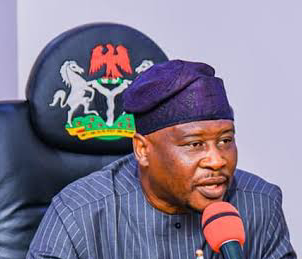
Adamawa State Governor Ahmadu Umaru Fintiri has inaugurated members of the National Council on Livestock Development and its Technical Committee, in a renewed effort to reposition Nigeria’s livestock industry as a major engine for economic diversification, food security, rural development and peacebuilding.
Speaking at the inauguration in Yola, Governor Fintiri—represented by Deputy Governor Professor Kaletapwa Farauta—called on the Federal Ministry of Livestock Development to fast-track support for the state’s Natural Resource Fund Grant Application submitted to President Bola Ahmed Tinubu in May 2024. The proposed programme, titled “Improving Livestock Productivity and Mitigation of Herders–Farmers Conflict through Effective Utilization of Grazing Reserves,” seeks funding to address longstanding challenges in the sector.
Farauta further appealed for federal assistance toward the establishment of a Model Demonstration Pilot Ranch under the National Livestock Transformation Plan (NLTP), emphasizing the initiative’s role in promoting ranching, fodder production and value-chain expansion.
She highlighted extensive ongoing reforms in Adamawa’s livestock sector, including the rehabilitation and demarcation of 69 grazing reserves—32 gazetted and 37 ungazetted—along with the development of stock routes, desilting of dams and installation of watering points. A state office for the NLTP has also been set up to boost pasture development at the Gongoshi Grazing Reserve.
Additional interventions outlined include the modernization and construction of international cattle and livestock markets, rehabilitation of the Yola Ultra-Modern Abattoirs and the construction of advanced veterinary hospitals, clinics and laboratories. The state has also established Artificial Insemination Centres across its three geopolitical zones, alongside cold-chain facilities and milk collection hubs operated by L-Press.
According to the deputy governor, these measures aim to strengthen animal health systems, particularly in disease surveillance and vaccination against CBPP, FMD, PPR, HS, LSD and rabies.
In his remarks, Minister of Livestock Development Idi Mukhtar Maiha, who chaired the maiden meeting of the council, urged members to deepen collaboration and attract more investment into the livestock value chain. He explained that the ministry was created to modernize the sector and curb conflicts, guided by the National Livestock Growth Acceleration Strategy (NL-GAS), the National Livestock Master Plan and other policy frameworks.
The council—made up of commissioners and directors of livestock development from all 36 states and the FCT, alongside key industry stakeholders—met under the theme “Livestock Rebirth: Accelerating Renewed Hope.” The initiative targets expanding the livestock industry’s value from $32 billion to $74 billion within the next five years.
Maiha disclosed that several companies have expressed interest in investing in dairy, beef, fodder, small ruminants, animal breeding, poultry and piggery production. He added that the ministry has registered eight new pasture species, rehabilitated the National Veterinary Research Institute in Vom and increased national vaccine production capacity from 120 million to 850 million doses annually.
“Our target to double national milk production from 700,000 to 1.4 million metric tons annually is now within reach,” the minister said, emphasizing the need to reduce Nigeria’s $1.5 billion annual dairy import bill.