

For women participating in the Nigeria for Women Programme Scale-Up (NFWP-SU) in rural Gombe State, regular access to programme support depends largely on the ability of field personnel to reach their communities.
But for Local Field Supervisors (LFSs) and Women Affinity Group (WAG) Supervisors, transportation difficulties have often posed a challenge to attending group meetings, monitoring activities, following up with beneficiaries and providing timely guidance.
The challenge is particularly significant in rural communities where field officers are expected to move between locations to ensure that women affinity groups remain actively engaged in the programme.
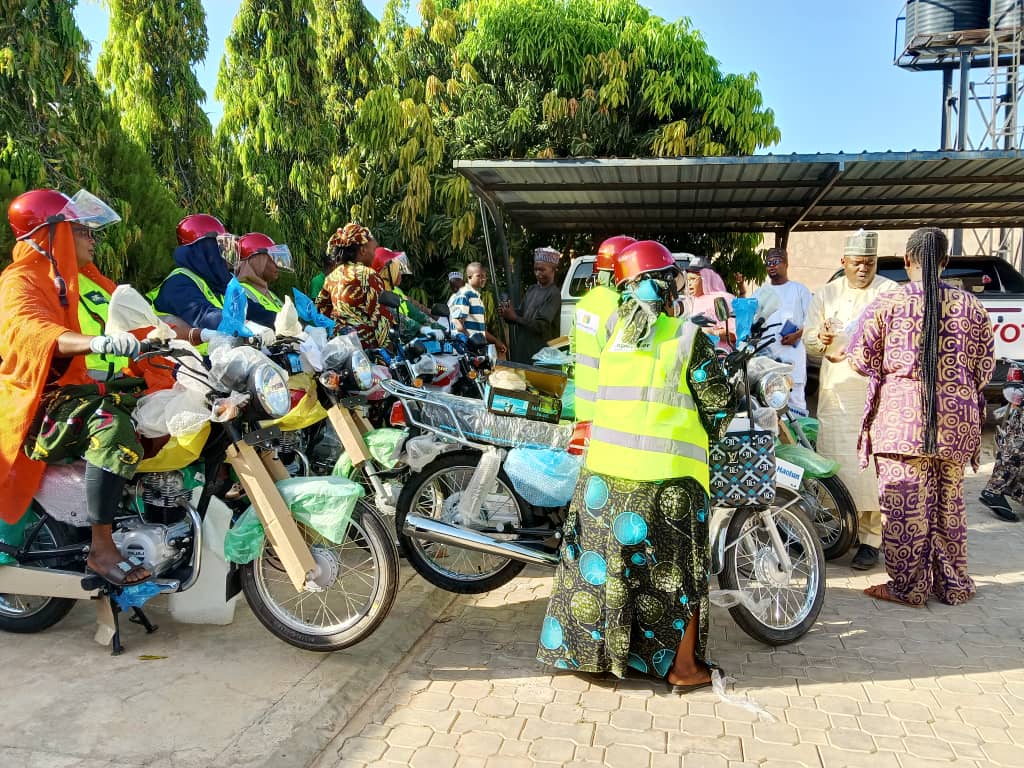
To address this gap, NFWP-SU Gombe State, with support from the Gombe State Government and World bank, has distributed 12 motorcycles to its Local Project Implementation Units (LPIUs) in Funakaye, Balanga and Yamaltu-Deba Local Government Areas.
The Gombe State Project Coordinator, Hajiya Hauwa Ibrahim Hassan, presented the motorcycle keys to representatives of the beneficiaries, comprising three Local Field Supervisors LFS and nine WAG Supervising Officers WAGSOS from the three participating LGAs.
While presenting the motorcycles, she urged the beneficiaries to use them strictly for official assignments and ensure proper maintenance to promote their sustainability.
She noted the importance of responsible use in ensuring that the motorcycles continue to serve the purpose for which they were provided.
To promote safe use, the Environmental and Social Safeguards (ESS) Officer, Zarahdeen Ubali, sensitised the beneficiaries on road safety, responsible riding and compliance with traffic regulations, emphasising the need to take necessary precautions to prevent accidents.
For the field personnel, the intervention is expected to make a practical difference in their daily responsibilities.
Speaking on behalf of the beneficiaries, Hauwa Ibrahim Musa, Munatu Simon and Rhoda Jauro said the motorcycles would ease transportation difficulties, improve movement between communities and enable them to reach Women Affinity Groups more regularly.
They explained that improved mobility would support more consistent monitoring of group activities, timely follow-up with beneficiaries and stronger engagement with women at the grassroots.
Beyond providing transportation, the intervention is expected to strengthen the link between programme structures and the women they serve, particularly those in rural and underserved communities.
With improved access to WAGs, field personnel will be better positioned to identify implementation challenges, provide guidance and monitor progress, helping women sustain their participation in group activities and benefit from the programme.
The effectiveness of the intervention will ultimately be reflected in more regular field visits, improved supervision and timely support reaching the women who need it.