

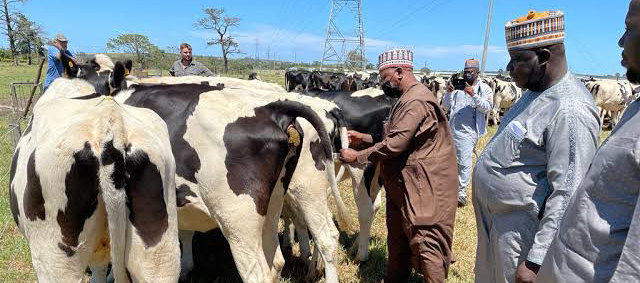
The Taraba State Government has commissioned key livestock infrastructure and distributed productive assets to farmers under the World Bank–supported Livestock Productivity and Resilience Support Project (L-PRES), as part of efforts to enhance food security and strengthen the state’s livestock sector.
The facilities were inaugurated at the weekend at the Veterinary Hospital Complex in Jalingo by the Commissioner for Agriculture and Food Security, Professor Nicholas Oliver Namessan.
Speaking at the event, Namessan said the initiative demonstrated the state government’s commitment to transforming the livestock sector to drive economic growth, improve livelihoods and ensure sustainable food security.
The commissioned facilities include a Disease Surveillance Laboratory, a solar-powered cold chain facility, an Artificial Insemination Centre and a milk cooling van. According to the commissioner, the infrastructure will strengthen animal health systems, improve disease detection and control, boost livestock productivity and support the One Health approach that integrates animal, human and environmental health.
Namessan also announced the distribution of 200 fodder choppers and 30 motorcycles to livestock farmers and extension service providers. He said the assets would enhance feed processing, increase productivity and improve extension service delivery, particularly in rural areas.
He commended the L-PRES State Coordinating Office for the effective implementation of the project and expressed appreciation to the Federal Government and development partners, especially the World Bank, for their continued support. He urged beneficiaries to use the facilities and assets responsibly to ensure long-term impact.
In his remarks, the State Project Coordinator, Mr Hananiah G. Albert, described the commissioning as a major milestone in the implementation of L-PRES in Taraba State.
Albert said the project has made targeted investments across priority livestock value chains—cattle, sheep and goats, poultry and dairy across the state’s 16 local government areas. He recalled that a similar exercise was carried out in November 2024, during which fodder choppers and pasture seeds were distributed to livestock cooperative groups, noting that the current intervention builds on those efforts.
He explained that the newly commissioned facilities were designed to address critical gaps in the livestock sector, including disease surveillance, vaccine storage, genetic improvement, dairy value chain development and extension service delivery.
Albert added that the motorcycles would improve access to remote livestock communities, while the fodder choppers would enhance feed efficiency, particularly during the dry season.
He further disclosed that L-PRES would soon enter into a Public-Private Partnership through a Memorandum of Understanding to ensure effective management and long-term sustainability of the facilities located within the Veterinary Hospital premises.
Albert assured stakeholders that additional investments in infrastructure, capacity building, market systems and resilience-focused interventions are planned for the remaining years of the project.
Both speakers commended Governor Agbu Kefas for his leadership and reaffirmed the state government’s commitment to building a resilient, competitive and inclusive livestock sector in Taraba State.