

By Rebecca Caleb Maina
In a landmark effort to build grassroots resilience against future health crises, stakeholders from across North-East Nigeria have validated inclusive, community-driven strategies aimed at ensuring no one is left behind in pandemic preparedness and response efforts.
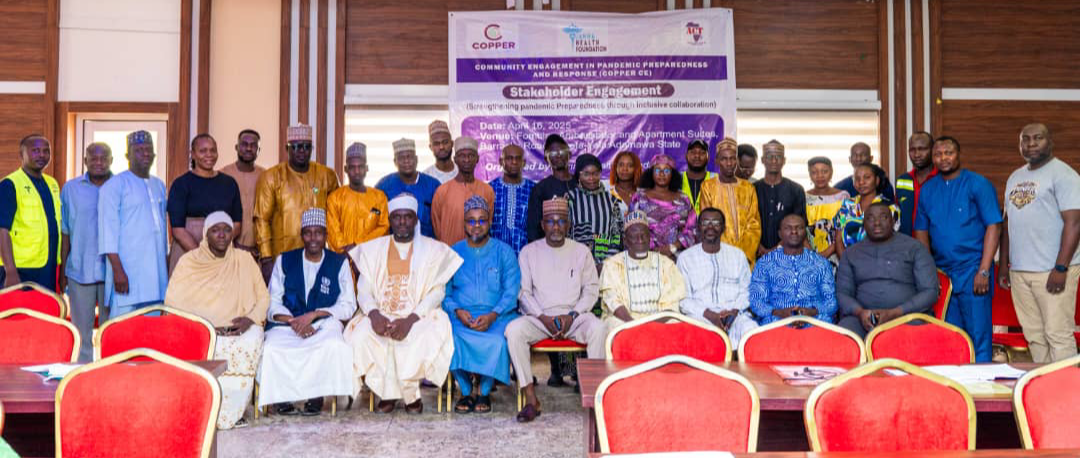
The two-day strategic meeting, held from April 16–17, at Fombina Ambassador and Apartment Suites in Jimeta-Yola, brought together representatives from Adamawa, Bauchi, Gombe, Taraba States, and the Federal Capital Territory.
The event was organised under the Community Engagement and Pandemic Preparedness and Response (COPPER CE) project, led by Janna Health Foundation in collaboration with the SUFABEL Consortium and supported by ACT Africa.
Addressing Historical Health Disparities
The discussions focused on addressing long-standing inequities in Nigeria’s health system, particularly in how emergencies like Ebola and COVID-19 exposed challenges in reaching vulnerable populations such as nomads, internally displaced persons (IDPs), and Almajirai. These groups have historically been sidelined due to limited access, language barriers, and minimal inclusion in health planning.
Stakeholders emphasized the need for inclusive, community-led governance that tackles misinformation, boosts trust, and ensures equitable health outcomes during pandemics.
Validating Community-Led Approaches
The meeting showcased findings from various COPPER CE activities, including community scorecard pilots, interviews, focus group discussions, and a review of Nigeria’s Pandemic Preparedness and Response Framework.
These highlighted critical gaps in community engagement and stressed the importance of rights-based approaches that prioritize gender and inclusion.
“We shared the findings from community-level work and validated advocacy agendas to strengthen local voices in pandemic decision-making,” said Paul Balogun of the COPPER CE project.
Endorsements from Government and Development Leaders
Key stakeholders delivered messages of support. Mr. Nuhu Yahaya of the Adamawa State Ministry of Health, representing the Director of Public Health, stated, “Community-driven sustainability is crucial for long-term health outcomes. We must give voice to the unheard.”
Paul Majam from the Nigeria Centre for Disease Control (NCDC) reinforced this, saying, “This aligns with our vision of a resilient health system that leaves no one behind.”
Dr. Suraj Abdulkarim, SUFABEL founder, acknowledged past gaps in inclusion and praised ongoing efforts to reverse this trend. “This consortium is working to bring historically excluded populations into health planning and action.”
Dr. Stephen John, founder of Janna Health Initiative (JHI), shared the organisation’s impact: over one million people treated for tuberculosis, 15,000 screened for leprosy, and 500 successfully treated—achievements that earned international recognition, including an award in Geneva.
Joining virtually, Dr. Ibrahim Tajudeen Olaitan, Executive Secretary of the Country Coordinating Mechanism (CCM), underscored the importance of local participation. “Community involvement in pandemic preparedness isn’t optional—it’s essential.”
Forging a Replicable Model for Nigeria
The gathering also served as the second Coalition Review Meeting under the COPPER CE project, enabling stakeholders to solidify partnerships and align on advocacy and implementation strategies. Attendees endorsed the COPPER CE model as a scalable framework for strengthening pandemic preparedness across Nigeria and beyond.
Participants included representatives from civil society organisations (CSOs), community-based organisations (CBOs), state ministries of health, the NCDC, CCM, NYSC, traditional and religious leaders, media, and international development partners.
About COPPER CE
The Community Engagement and Pandemic Preparedness and Response (COPPER CE) project, supported by ACT Africa, works to elevate the voices of marginalised populations, foster community-led health governance, and build inclusive, evidence-based systems to respond effectively to public health emergencies.