

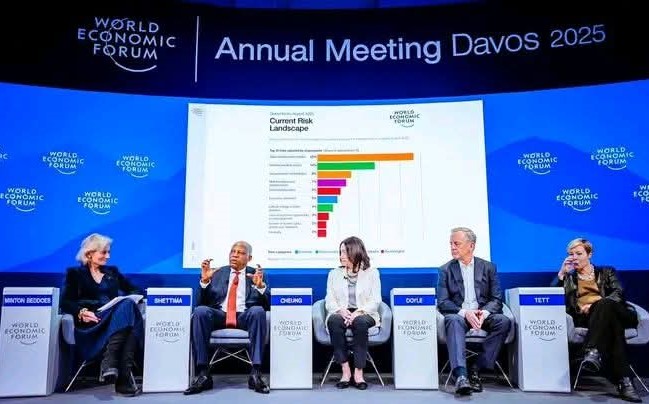
At the 2025 World Economic Forum in Davos, Switzerland, Nigeria’s Vice President Kashim Shettima reaffirmed the nation’s commitment to driving Africa’s transformation through youth empowerment, education, and agricultural innovation.
Speaking at the Financial Times Global Risk Roundtable, Shettima emphasized that Africa’s young population is central to global progress.
The Vice President highlighted the dual nature of challenges, describing them as opportunities for growth and reinvention.
Drawing inspiration from the Chinese word for crisis, “Wei Ji,” he explained, “Wei stands for danger, while Ji represents opportunity. Yes, we have challenges, but those challenges are pregnant with opportunities to re-engineer our society and build back better.”
Shettima underscored the importance of prioritizing education, gender-focused initiatives, and smart agriculture as pillars to propel Nigeria’s economy into the fourth industrial revolution.
“This crisis has given us a unique opportunity to invest in people, especially in areas that will enable us to leapfrog our economies into global competitiveness,” he stated.
Rejecting reliance on foreign aid, the Vice President called for equitable global partnerships that preserve dignity and foster mutual respect. “I don’t believe in aid; I believe in partnership. I’d rather carry my poverty with dignity and deal with people, nations, and companies on a pedestal of equality, not in a master-servant relationship,” he asserted.
Shettima expressed optimism about Africa’s potential, describing the continent as rich in resources and poised to drive global growth. “My continent is the richest in the world, and the trajectory of global growth is facing Africa. Nigeria will make or mar that transition. The youths of Africa are the drivers of change,” he declared.
Acknowledging global crises, including conflicts in Ukraine, the Middle East, and Sudan, the Vice President stressed their impact on supply chains, humanitarian challenges, and peace. He called for multilateral solutions to address interconnected challenges.
“There is an incestuous relationship between economy and ecology in the African continent. But hope springs eternal in the hearts of men. As members of the same human family, we can find solutions to our challenges. We must look inward to solve our problems, but multilateralism is key. These challenges are global, and we must fuse into one human family to overcome them,” Shettima concluded.
The Vice President’s remarks, was observed to have underscore Nigeria’s resolve to lead Africa’s transformation by fostering innovation, strengthening education, and empowering its youthful population.