

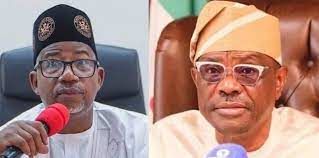
When the hands that once clasped in solidarity between political associates transform into fists of fury, the consequences are catastrophic. The very foundations of trust crumble, leaving behind a landscape of shattered alliances, broken vows, and irreparable damage.
The Nigerian political landscape, once thought to be a bastion of unity and cooperation, is forever fractured, a testament to the destructive power of betrayal and the fleeting nature of loyalty in the corridors of power.
The political landscape is often a stage where friendships blossom and wither, alliances shift like desert sands, and yesterday’s comrades become today’s rivals.
A stark illustration of Nigeria’s conflicting political landscape is the deteriorating relationship between Bauchi State Governor, Bala Mohammed, former Rivers State Governor, Nyesom Wike, and former Speaker of the House of Representatives, Yakubu Dogara. What was once a formidable alliance has devolved into a bitter feud, exposing the fragile nature of loyalty and the all-consuming allure of ambition in Nigerian politics.
The once-cordial relationship has given way to recriminations, with each side trading accusations and counter-accusations. This dramatic fallout serves as a poignant reminder of the ephemeral nature of political alliances in Nigeria.
This isn’t simply a personal falling out. It is a complex interplay of conflicting interests and the machinations of political interest groups. As we navigate Nigeria’s diverse political landscape, it is crucial to understand that conflict is an inherent part of the process. As Webster’s Dictionary defines it, conflict encompasses “fight, contest, strife, quarrel, emotional disturbance, to be at variance, to clash, to struggle.” Given our rich tapestry of ethnicities, religions, and regional affiliations, these clashes are perhaps inevitable. The challenge lies in how our leaders manage these differences, especially considering the high degree of public trust that leadership demands.
The breakdown of the relationship between Mohammed, Wike, and Dogara, though its precise causes remain obscured by political maneuvering, exemplifies a persistent challenge in Nigerian politics: the conflict between individual ambition and the pursuit of the common good. While the specifics of their falling out – likely involving strategic positioning and power plays – are subject to speculation, the broader narrative resonates deeply.
One must question whether their initial alliances were founded on genuine shared principles or were simply tactical arrangements of political convenience. The current animosity between them strongly suggests the latter, raising legitimate concerns about the transactional nature of politics and the ever-present risk of personal agendas eclipsing the needs of the electorate. This situation underscores the need for greater transparency and accountability, lest the pursuit of power continue to overshadow the true purpose of public service.
As mentioned earlier, while the specific details of their falling out might be shrouded in political maneuvering and strategic posturing, the underlying theme resonates across the nation: the clash between personal ambitions and collective goals. Were their initial alliances built on genuine shared values, or were they merely convenient arrangements of political expediency? The current state of their relationship suggests the latter, raising concerns about the quid pro quo nature of politics.
Conflict, while often perceived negatively, isn’t inherently destructive.The International Contemporary Dictionary of Mass Communication and Media Studies defines conflict management as “the identification and control of conflict within an organisation,” outlining three core philosophies: the traditional view that all conflict is detrimental; the perspective that conflict is inevitable and can be constructively channeled; and the belief that conflict is essential for organisational survival and evolution.
This apparent breakdown of the Mohammed-Wike-Dogara alliance, though seemingly a setback, could be interpreted through this lens of positive conflict management. Rather than simply a failure, this dissolution might expose underlying tensions and power dynamics within the political landscape, potentially catalysing a necessary realignment of forces. Such a realignment could, in turn, foster greater transparency and accountability among political leaders, ultimately benefiting the democratic process.
The public is left to speculate about the precise reasons behind this falling out. Was it a disagreement over policy? A struggle for power within a particular political party? Or perhaps a clash of personalities? Regardless of the specifics, the situation underscores the need for leaders who can rise above personal differences and prioritise the common good. It serves as a reminder that the pursuit of power should not come at the expense of integrity and the trust placed in them by the electorate.
This conflict was amplified when Bauchi State Governor, Bala Mohammed, launched a scathing attack on Minister of the Federal Capital Territory, Nyesom Wike, labeling him a “transactional politician”. This verbal jab came after Wike criticised Mohammed’s opposition to President Bola Tinubu’s Tax Reform Bills. Mohammed’s camp responded by accusing Wike of being hypocritical and having a chameleonic behaviour, shifting his loyalty to further his personal ambitions.
The rift between the two politicians appears to be deepening, with Mohammed downplaying Wike’s threats against PDP governors supporting Rivers State Governor Siminalayi Fubara. Mohammed attributed Wike’s outbursts to frustration, stating that their disagreements are not personal.
Interestingly, former Speaker of the House of Representatives, Yakubu Dogara, had weighed in on the matter, expressing surprise at Mohammed’s attacks on Wike. Dogara alleged that Wike had financed Mohammed’s campaign to become governor, making Mohammed’s ingratitude all the more striking he said. In his article “GOV BALA vs HE WIKE: LET THE TRUTH BE TOLD” , Rt Hon Yakubu Dogara, highlighted the alleged ingratitude and treachery of Governor Bala Mohammed towards His Excellency Nyeson Wike.
Dogara claimed that Wike supported Bala Mohammed during the 2018 PDP Gubernatorial primaries, providing financial assistance and resources without demanding anything in return. He also alleged that Bala Mohammed had previously lied about his financial capacity and humiliated Wike when they were both ministers.
The Speaker questioned Bala Mohammed’s moral character, accusing him of being ungrateful and treacherous towards those who helped him. He also criticised Bala Mohammed for calling Wike “transactional” despite allegedly benefiting from Wike’s support.
While responding to Yakubu Dogara’s allegations, Governor Bala Mohammed fired back at the former Speaker, describing him as a hypocrite and political turncoat, a political conman known for betrayal, inconsistency , unstable and opportunistic.
Governor Mohammed’s response came amidst the ongoing feud between him and Dogara, who have been exchanging verbal blows in the media.
The governor’s statement is seen as a rebuttal to Dogara’s earlier claims, which Mohammed’s camp had dismissed as baseless and misinformed.
The rift between the two politicians has been escalating, with both sides trading accusations and counter-accusations. It remains to be seen how this situation will unfold.
While joining the fray, Alhaji Hamza Koshe Akuyam, former Chairman of the People’s Democratic Party (PDP) in Bauchi State, had countered former Speaker Yakubu Dogara’s claims about the relationship between Governor Bala Mohammed and Minister Nyesom Wike.
Akuyam described Dogara’s opinion as “inconsistencies and falsehoods,” stating that Governor Mohammed and Wike have always maintained a friendly relationship. He challenged Dogara to provide evidence to support his claims, offering an alternative narrative of events.
According to Akuyam, the current disagreement between Mohammed and Wike revolves around upholding the constitution and party conventions, rather than personal friendship. He emphasised that Governor Mohammed has consistently prioritised doing what is right for the party and the country.
Bauchi State Governor, Bala Mohammed has indeed made significant strides in the state since taking office. His impressive track record is evident in various sectors, including Infrastructure Development, where he has overseen the upgrade of the Bauchi regional water project, construction of roads, and renovation of schools.
The governor’s Focus on Education and Healthcare is also noteworthy, with initiatives aimed at reducing the number of out-of-school children and improving the state’s primary healthcare system. Additionally, his administration has launched programmes to empower women and youths, such as the Kaura Economic Empowerment Programme (KEEP), which provides grants, loans, and resources to beneficiaries.
Agricultural Initiatives are another area where Governor Mohammed has made a positive impact, with efforts to scale up commercial farming in the state and improve food security. His administration has also constructed connecting roads and launched projects to improve the state’s security situation.
It is clear that Governor Mohammed’s vision, commitment, and responsiveness have inspired many, and his continued leadership is expected to bring even greater achievements to Bauchi State in 2025. It will therefore not be out of place if he is encouraged to consider taking the lead in building bridges and fostering a spirit of cooperation. This would be a valuable contribution towards a more constructive and people-focused political environment.
It should be noted that the Mohammed-Wike-Dogara affair transcends the personalities involved; it serves as a potent microcosm of Nigeria’s complex political landscape. More than a simple tale of three politicians, it reveals the powerful undercurrents of ambition, the sting of perceived betrayal, and the constantly evolving nature of political alliances. This situation offers a valuable, albeit troubling, lesson. Moving forward, citizens must critically examine such instances and demand a more principled brand of leadership from those aspiring to public office.
Finally, only by learning from these examples can we hope to cultivate a political culture where genuine collaboration and the pursuit of shared goals for the betterment of the nation take precedence over personal ambition and the seductive allure of power. This requires a shift in voter expectations, demanding transparency, accountability, and a commitment to the common good, rather than simply rewarding political maneuvering.
By Shu’aibu Usman Leman,
(Former NUJ National Secretary)
Behind Yerima Giade House,
New GRA, Bauchi
email: shuaibuusmanleman@yahoo.com