

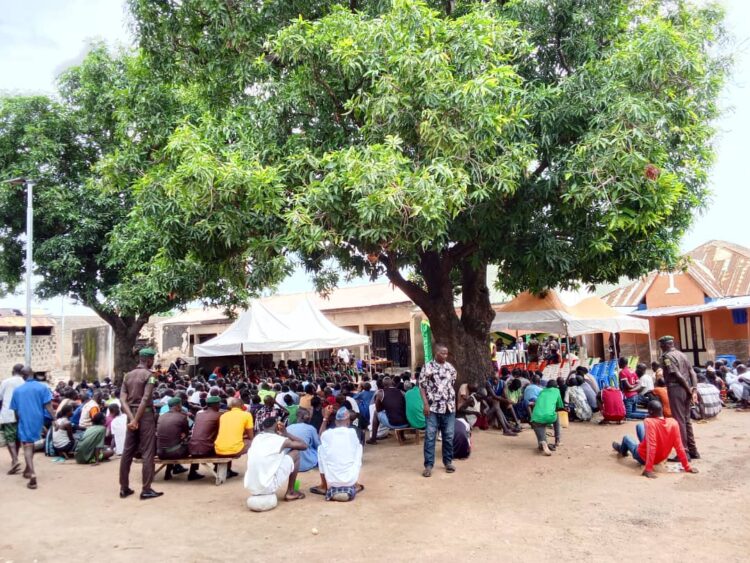
Behind the walls of the Jalingo Medium Security Custodial Centre, overcrowding has become more than a statistic. It is a daily reality for hundreds of inmates, many of whom are forced to share limited space and facilities in a centre built to accommodate only half their present population.
Designed for about 250 inmates, the facility is currently holding more than 500 persons, according to findings presented during a recent assessment.
About 250 inmates are reportedly sleeping on mats, while a significant number remain in custody awaiting trial.
For those behind the walls, the long wait for justice can be as difficult as the conditions within the facility itself. Some inmates have spent considerable periods awaiting the determination of their cases, adding pressure to an already overstretched custodial system.
The situation has now drawn renewed attention from the Taraba State Government and justice-sector stakeholders, who are exploring ways to reduce the inmate population while ensuring that deserving persons are not unnecessarily kept behind bars.
At the weekend, a delegation comprising officials of the state government, members of the Nigeria Bar Association (NBA) and the Legal Aid Council visited the centre to assess the situation and examine possible solutions to the congestion.
The delegation, led by the State Attorney-General and Commissioner for Justice, Yakubu Maikasuwa (SAN), was received by the Controller of Corrections, Taraba State Command, John Francis.
Francis used the opportunity to highlight the challenges confronting the centre, identifying overcrowding, inadequate facilities and delays in the administration of justice as major concerns.
He argued that reducing congestion would require more than expanding the physical infrastructure of the centre. According to him, greater attention must be paid to the justice process that determines how long inmates remain in custody.
He called for the speedy determination of cases, regular review of inmates’ cases and wider application of non-custodial measures. Plea bargaining, where appropriate, he said, could also help reduce the number of people held in custody while allowing the justice system to achieve its objectives.
But beyond the question of pending cases, Francis drew attention to another category of inmates — those who have demonstrated that they are capable of turning their lives around.
He urged the government to consider inmates who had maintained good conduct, acquired vocational skills or education and shown evidence of rehabilitation for possible release under existing legal provisions.
For the Taraba Government, that possibility is already receiving attention.
Maikasuwa disclosed that the state Committee on the Prerogative of Mercy was considering the issue and would recommend inmates who met the required conditions for amnesty.
“We have this committee we call the Committee on the Prerogative of Mercy. There are guidelines upon which the committee can make recommendations, either bordering on ill health, good conduct, and then persons who have substantially served their sentences,” he said.
The Attorney-General said the committee would meet as soon as possible to consider eligible inmates, with those found deserving to benefit from the amnesty process.
He stressed, however, that the process would be guided by established criteria, including the health condition and conduct of inmates as well as the proportion of their sentences already served.
While Maikasuwa described the overall condition of the custodial centre as fair, he acknowledged that improvements were necessary. He assured that Governor Agbu Kefas would intervene in areas where government assistance was required.
For the NBA, the challenge also requires attention to the legal circumstances keeping inmates behind bars.
The Chairman of the NBA, Jalingo Branch, David Philemon, disclosed that the Prison Decongestion Committee was already working to reduce the population at the centre and address legal issues contributing to prolonged detention.
He said the committee would also review cases involving fines, stressing the need to prevent situations where inmates remained in custody unnecessarily when there were lawful avenues for their release.
The developments point to a broader question about the purpose of incarceration: whether custodial centres should merely hold people or also provide an environment where rehabilitation, justice and reintegration can take place.
The call for consideration of inmates who have acquired education and vocational skills is particularly significant. It suggests an attempt to recognise rehabilitation as an important component of the justice system rather than viewing imprisonment solely as punishment.
Yet, with the Jalingo facility holding more than twice its designed capacity, the immediate challenge remains formidable.
Unless pending cases are resolved faster, non-custodial alternatives are expanded and eligible inmates are released through lawful processes, congestion may continue to undermine the effectiveness of the facility and the welfare of those held there.
For Taraba, therefore, the proposed amnesty may provide temporary relief, but stakeholders say a lasting solution will require sustained judicial intervention, improved infrastructure, regular case reviews and stronger rehabilitation programmes.
Inside the walls of the Jalingo custodial centre, the numbers tell one part of the story. Behind each number is an individual waiting — some for trial, some for release, and others for a second chance.