

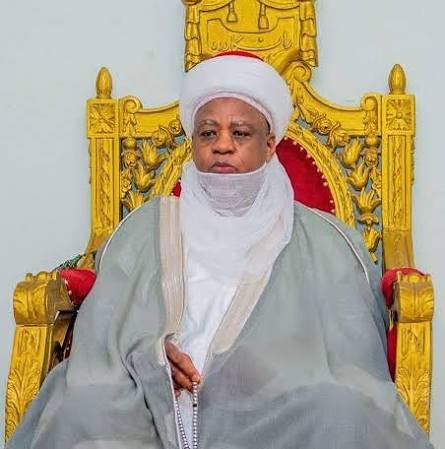
Sultan Sa’ad Abubakar III at 70: MPAC Hails Royal Icon of Faith and National Unity
His Eminence, Alhaji Muhammad Sa’ad Abubakar III, the 20th Sultan of Sokoto and President-General of the Nigerian Supreme Council for Islamic Affairs (NSCIA), has been described as a symbol of faith, national unity and peaceful coexistence as he marks his 70th birthday.
The Executive Chairman of the Muslim Public Affairs Centre (MPAC) Nigeria, Disu Kamor, gave the description in a tribute titled, “At 70: Sultan Muhammadu Sa’ad Abubakar III – A Royal Icon of Faith and National Unity.”
Kamor said the Sultan’s 70 years of life and 20 years on the throne had produced a remarkable legacy of bridge-building, religious tolerance and national cohesion.
He recalled that when the Sultan marked his 10th anniversary on the throne a decade ago, he described him as a leader who had built “strong bridges of understanding and brotherhood across Nigeria.”
According to Kamor, two decades into the Sultan’s reign, that assessment had developed into a lasting legacy, particularly through his efforts to unite Muslims and promote peaceful relations between Muslims and Christians.
He noted that as President-General of the NSCIA, the Sultan occupied a strategic position in efforts to unite Nigeria’s diverse Muslim communities across the North and South.
Kamor said the monarch had consistently opposed attempts to divide the Muslim Ummah along regional or sectarian lines, helping to sustain a common platform for Muslims across the country.
He also described the Sultan’s contribution to interfaith relations as significant, particularly during periods of heightened religious tension and insecurity.
According to him, at the height of the Boko Haram insurgency in 2012, Sultan Sa’ad Abubakar and the then Catholic Archbishop of Abuja, Cardinal John Onaiyekan, were jointly nominated for the Nobel Peace Prize for their efforts to promote Muslim-Christian dialogue.
He further recalled the Sultan’s participation in initiatives aimed at strengthening interfaith understanding, including a joint Muslim-Christian delegation to Nigeria in 2012.
Kamor said the Sultan had consistently advocated dialogue and peaceful coexistence, maintaining that Muslims and Christians were destined to live together peacefully and should embrace mutual respect rather than suspicion.
“These are not the words of a sectarian leader,” Kamor said, describing the Sultan as a national figure whose influence transcends religious and regional boundaries.
He cited commendations from President Bola Tinubu, former Vice President Atiku Abubakar and Katsina State Governor Dikko Radda, who, according to him, had all recognised the Sultan’s role as a bridge-builder and stabilising voice in the country.
Kamor quoted President Tinubu as describing the Sultan as “a stabilising voice in times of turbulence, a bridge-builder across faiths and communities, and a moral compass not only for our Muslim ummah, but for our entire nation.”
He added that Atiku described the monarch as “a symbol of wisdom, unity and peaceful leadership,” while Governor Radda acknowledged his calm leadership during periods of tension and his role in providing wise counsel.
The MPAC chairman also highlighted the Sultan’s military background, saying it had influenced his leadership style and approach to national challenges.
He recalled that Sultan Sa’ad Abubakar was commissioned into the Nigerian Army’s Armoured Corps in 1977 and later participated in peacekeeping operations before rising to the rank of Brigadier General.
He ascended the throne in 2006 following the death of his elder brother, Sultan Muhammadu Maccido.
Kamor said the discipline acquired during his military career had remained evident in the Sultan’s handling of national crises, particularly his emphasis on restraint, dialogue and collective action.
He said the monarch had continued to call on governments, security agencies, traditional institutions and citizens to work together in tackling insecurity, including banditry in the North-West.
According to him, the Sultan’s influence has also received international recognition, with his name featuring for years among the world’s most influential Muslims in The Muslim 500, published by the Royal Islamic Strategic Studies Centre in Jordan.
Kamor said the Sultan’s leadership had often been defined by restraint rather than confrontation, describing his ability to manage sensitive national issues without escalating tensions as one of his greatest strengths.
He maintained that the Sultan’s influence should be measured not only by his traditional position but also by his contribution to sustaining dialogue, religious tolerance and national unity during some of Nigeria’s most challenging periods.
“As he turns 70, and 20 years into a reign that has outlasted several political administrations and weathered some of the country’s most dangerous sectarian moments, Sultan Sa’ad Abubakar has earned his place as more than a royal father to Muslims,” Kamor said.
He added that the Sultan had emerged as one of the prominent Nigerian leaders whose personal authority and commitment to peaceful coexistence had contributed to strengthening national unity.
Kamor congratulated the Sultan on his 70th birthday and prayed for continued health, wisdom and strength, expressing hope that the bridges of unity and understanding he had built would endure for generations.
“May the Almighty grant him continued health, wisdom, and strength, and may the bridge he has spent a lifetime building continue to stand long after the builder has gone to his rest,” he said.