

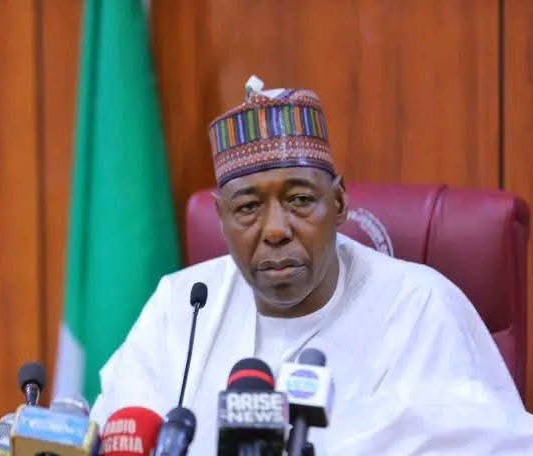
Governor Babagana Umara Zulum of Borno state, has called for a fundamental shift in Nigeria’s approach to agricultural mechanisation, urging the country to move beyond the mere purchase and ownership of tractors towards a modern, service-driven and investment-focused agricultural system.
Zulum made the call in Abuja while speaking at a High-Level National Policy Dialogue on Agricultural Mechanisation organised by the Federal Ministry of Agriculture and Food Security.
The governor identified low productivity, limited access to technology, inadequate investment and weak agricultural value chains as some of the major challenges hindering the growth of Nigeria’s agricultural sector.
He said agricultural mechanisation should be provided as a service, enabling farmers to access timely land preparation, precision farming, irrigation and other modern technologies without necessarily having to own expensive machinery.
According to him, such an approach would improve productivity, reduce the burden of manual labour and make modern agricultural technologies more accessible to smallholder farmers.
Speaking on Borno’s agricultural transformation efforts, Zulum said massive investment in the sector by his administration remained central to rebuilding livelihoods and restoring communities affected by insecurity and displacement.
He outlined a four-pronged approach to agricultural mechanisation, comprising the mechanisation of agriculture to boost productivity and reduce drudgery; digitalisation to enhance precision, intelligence and efficiency; regeneration of agricultural resources to ensure sustainability; and investment in infrastructure, technology and enterprises to drive transformation.
Zulum also advocated stronger private-sector participation and innovative financing mechanisms to support local manufacturing and assembly of agricultural machinery.
He said investment should also target irrigation, renewable energy, storage, processing, value addition, as well as youth- and women-led agricultural enterprises.
The governor stressed that Nigeria must avoid simply reproducing outdated agricultural practices, but instead build an agricultural system that is modern, smart, climate-resilient, productive and inclusive.
He said the ultimate objective should be to establish an agricultural economy capable of feeding the nation, competing in the global market, creating employment opportunities and delivering sustainable prosperity to rural communities.