

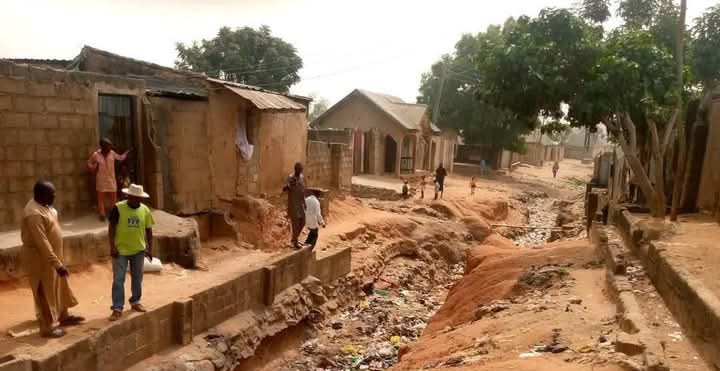
By all accounts, life in Mallam Joda, one of Jalingo’s oldest neighborhoods has never been easy. But for residents like Musa Abdul, a weather-beaten farmer with calloused hands and quiet resolve, life lately has become a test of endurance.
“You can spend the whole day on a trip that should take ten minutes,” he said, squinting toward the collapsed stretch of road that connects his farm to the rest of the city. “And if it rains? Forget it. Nobody moves.”
This is no exaggeration. In Mallam Joda, located in the heart of Jalingo metropolis, what used to be a modest access road has crumbled into a jagged maze of potholes, mud, and despair.
The road, which threads through homes, shops, schools, and farms, is now a daily obstacle course one that’s claimed livelihoods, delayed emergency responses, and eroded any sense of safety or ease.
On Sunday, the community’s frustration spilled formally onto paper. A letter signed by Al-Emran Alhassan on behalf of the residents was sent to the Taraba State Government, appealing directly to Governor Dr. Agbu Kefas for urgent intervention.
In the letter, the residents didn’t mince words. “This road has become a threat to our lives and livelihoods,” it reads. “It has made transportation risky, delayed emergency services, and disconnected us from essential institutions.”
From traders who watch their goods spoil in transit, to parents who dread the daily school run, and health workers who must improvise care when ambulances can’t get through everyone in Mallam Joda has a story.
Fatima, a community health worker, recalls a day that still shakes her. “An ambulance got stuck trying to reach a woman in labor,” she said. “We had no choice but to deliver the baby ourselves. Thankfully, it ended well—but it could’ve easily gone the other way.”
Then there’s Ibrahim, a keke driver who used to make a decent living ferrying passengers. Now, he spends more time fixing his tricycle than using it. “My shock absorbers are gone. Every trip is a gamble,” he said, shaking his head.
For the community, the issue is no longer just about infrastructure, it’s about survival. Floods have worsened the erosion. Crops rot before they can reach market. Children miss school. Families fall ill. And despite numerous petitions to local authorities, little has changed.
That’s why, in their appeal to the governor, the residents outlined clear, actionable requests: send engineers to assess the damage, allocate funds for a full repair, and ensure transparency in the execution of the project.
“We’re not asking for luxury,” their letter states. “We’re asking for the chance to live and work in dignity.”
In a city growing rapidly, where progress seems to touch everywhere but the margins, Mallam Joda’s residents are holding onto hope that their voices will finally be heard.