

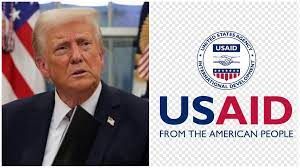
The Trump administration, backed by billionaire Elon Musk, has moved to dismantle the U.S. Agency for International Development (USAID), a key organization that funds education, fights poverty, and provides humanitarian aid worldwide.
The decision has set up a fierce confrontation with Congressional Democrats, who argue that the move is illegal and have vowed to challenge it in court
In one of the most dramatic clashes over President Donald Trump’s efforts to reshape the federal government, Democratic lawmakers attempted to enter USAID headquarters on Monday but were blocked by security officers.
Secretary of State Marco Rubio, despite USAID’s status as an independent agency for over 60 years, claimed he was now its acting administrator.
Trump defended the move, telling reporters that shutting down USAID “should have been done a long time ago.” When asked if he needed congressional approval, he dismissed the idea. Meanwhile, Musk, who has been given sweeping authority in the administration’s budget-cutting efforts, declared, “We’re shutting it down.”
Outside USAID headquarters, lawmakers denounced the administration’s actions as a constitutional crisis. “We don’t have a fourth branch of government called Elon Musk,” said Rep. Jamie Raskin (D-Md.), emphasizing concerns over Musk’s influence in Washington.
Sen. Chris Van Hollen called the move an “illegal power grab” and an “abuse of power.” Democrats have already begun preparing legal challenges and are considering blocking Trump’s State Department nominations in retaliation. However, with Republicans controlling both chambers of Congress, their options are limited.
The abrupt dismantling of USAID has already had global repercussions. The agency, which operates in 120 countries, has seen thousands of employees laid off and crucial programs halted. The cuts have forced international organizations to shutter operations, leaving millions without access to food, medicine, and education.
Among the affected programs is the widely praised HIV/AIDS initiative launched under President George W. Bush, which has saved millions of lives in Africa. Aid shipments, including vital medications, are now stuck at ports, unable to be delivered.
Additionally, education programs for Afghan girls, efforts to combat an Ebola outbreak in Uganda, and famine prevention initiatives have all been disrupted. Some aid organizations have filed for bankruptcy after USAID stopped paying for previously approved projects.
The decision to dissolve USAID is the latest in a series of moves by Trump and his Republican allies to overhaul U.S. foreign policy. Critics argue that dismantling humanitarian aid efforts could weaken American influence and give adversaries like China and Russia more room to expand their global presence.
Sen. Brian Schatz warned of the broader implications, stating, “There’s a reason USAID is part of American foreign policy—because a stable world means a stable America.”
As the battle over USAID intensifies, Democrats are preparing to take the fight to the courts, setting the stage for a high-stakes legal and political showdown over the future of U.S. foreign aid.