

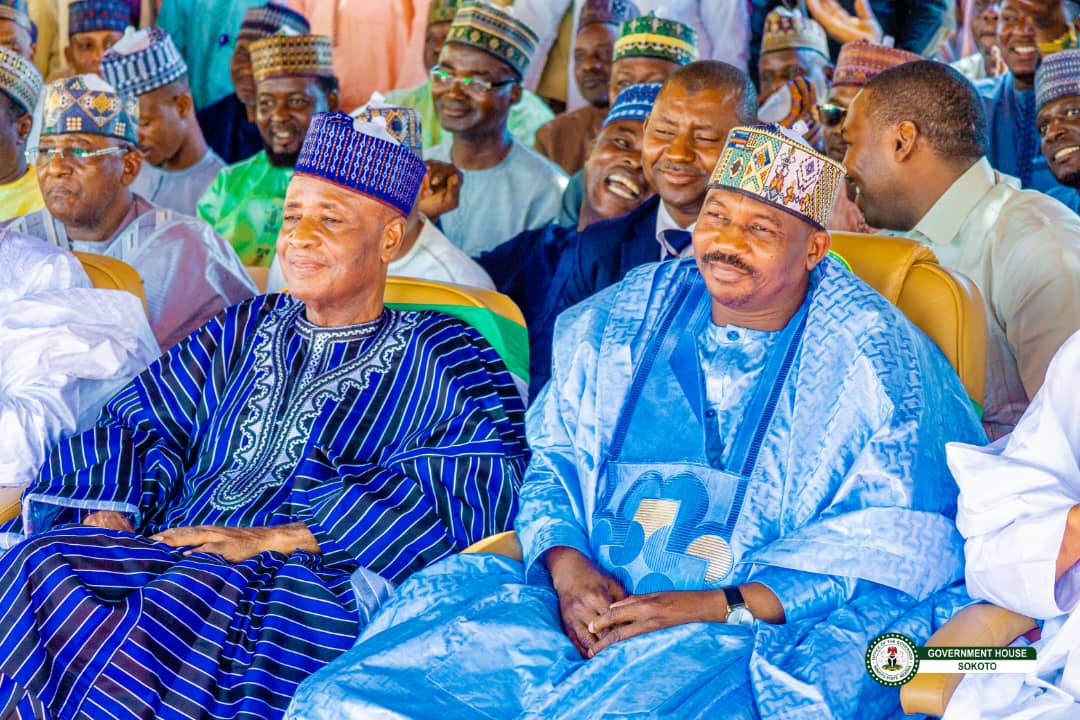
By all indications, the dynamics of electoral politics are changing. Across democracies, voters are increasingly demanding tangible results, accessibility and visible leadership from those seeking their mandate. In Sokoto State, this emerging political reality is already shaping conversations ahead of the 2027 elections, as Governor Ahmed Aliyu’s administration continues to highlight projects and interventions across the state.
Nigerian politics has traditionally been characterised by political rhetoric, media battles and high-profile criticism. But elections are ultimately decided beyond television studios and social media platforms. They are won in communities, markets, schools, hospitals and villages where voters experience the impact—or absence—of government.
For Governor Ahmed Aliyu, the strategy appears to be centred on making governance visible.
Since assuming office in May 2023, the administration has pursued projects and programmes covering infrastructure, education, healthcare, agriculture, rural development and security. Across Sokoto metropolis and rural communities, the government says its interventions are designed to address long-standing development challenges and restore public confidence in governance.
One of the most visible aspects of the administration’s agenda is infrastructure.
Road construction and rehabilitation projects have become a prominent feature of the government’s activities, particularly within Sokoto metropolis and along strategic routes connecting communities. Township roads, drainage systems, streetlights and urban renewal projects have also formed part of the administration’s infrastructure drive.
For residents who have lived with deteriorating roads and inadequate drainage, such projects represent more than physical structures. They provide a direct measure by which citizens can assess government performance.
Infrastructure is particularly important politically because it is difficult to hide. A completed road, rehabilitated school, functioning drainage system or improved public facility remains visible long after political speeches have ended.
If sustained, the projects could therefore become an important part of the governor’s case for another term in office.
Education is another sector where the administration has sought to demonstrate its commitment through physical projects and human-capital interventions.
The government has embarked on the construction and renovation of classrooms, provision of furniture and distribution of learning materials across schools. It has also supported scholarship programmes for students studying within and outside Nigeria.
Teacher recruitment and the rehabilitation of educational infrastructure have similarly featured in the administration’s education agenda.
For parents, however, the real test is whether such interventions translate into better learning conditions and improved educational outcomes for their children. Where that happens, government programmes cease to be abstract policies and become personal experiences for families
Healthcare delivery is another area likely to influence voters, particularly in rural communities where access to medical services remains a major challenge.
The administration has renovated and upgraded primary healthcare facilities and provided medical equipment, while secondary healthcare institutions have also received attention.
Maternal and child healthcare programmes have featured prominently in the government’s interventions, reflecting the importance of reducing preventable health challenges among vulnerable populations.
For rural residents, the political significance of such interventions is straightforward: a functioning healthcare facility within a community can make a greater impression than a political speech delivered hundreds of kilometres away.
Agriculture and Rural Economy
Agriculture remains central to Sokoto’s economy, making support for farmers a potentially significant component of the administration’s rural strategy.
Government interventions have included the distribution of fertilisers, improved seedlings and other agricultural inputs, alongside programmes aimed at supporting livelihoods and strengthening household incomes.
For a largely agrarian population, agricultural support can have a direct impact on food production and family income.
The political importance of this constituency cannot also be underestimated. Rural communities constitute a substantial part of Sokoto’s electorate, and the ability of any political party to maintain a strong relationship with farmers and rural residents could prove decisive in 2027.
Security and the Politics of Presence
Security remains one of the biggest challenges confronting communities across the North-West.
Although the responsibility for internal security rests largely with federal security agencies, state governments play important supporting roles. The Sokoto administration has continued to provide logistical support to security agencies and engage traditional rulers, community leaders and other stakeholders in efforts to strengthen local intelligence and response mechanisms.
In communities affected by insecurity, however, voters are likely to judge government by the extent to which they feel protected and supported.
This brings the issue of political presence into sharper focus.
Beyond physical projects, accessibility may become one of the most important factors in the 2027 contest.
Governor Aliyu has maintained a visible presence at community engagements, social events, project sites and meetings with traditional institutions and other stakeholders.
That visibility contrasts with criticisms directed at some opposition figures associated with the political bloc of former Governor Aminu Waziri Tambuwal. Critics argue that some opposition politicians and elected representatives spend considerable time outside their constituencies, particularly in Abuja, limiting their direct engagement with the people they seek to represent.
Whether such criticism is fair or not, political absence can create a perception problem.
An electorate that rarely sees its representatives may begin to question their commitment, relevance and understanding of local concerns. Conversely, leaders who regularly return to their communities and remain accessible have an opportunity to build stronger personal relationships with voters.
In grassroots politics, accessibility can be as important as ideology.
Absentee politics may generate headlines, but it does not necessarily generate loyalty. Communities tend to develop stronger relationships with leaders they can see, approach and hold accountable.
Governor Aliyu’s political calculations are also strengthened by the influence of Senator Aliyu Magatakarda Wamakko, one of the most influential political figures in Sokoto State.
Over the years, Wamakko has built an extensive political network across the state’s 23 local government areas. His relationships with traditional institutions, community leaders, youth and women’s groups, as well as party structures, provide the APC with an established grassroots political base.
The relationship between Wamakko and Governor Aliyu therefore remains significant to the political equation ahead of 2027.
Supporters of the administration see the relationship as a combination of political experience, grassroots mobilisation and governance continuity.
They argue that the governor’s developmental agenda, backed by Wamakko’s political structure, gives the APC an advantage that opposition criticism alone may struggle to overcome.
For the opposition, the challenge will be to build an equally strong grassroots network and convince voters that it offers a more compelling alternative.
Why Performance Could Matter
The emerging political lesson in Sokoto is straightforward: performance can resonate more deeply than political noise.
Roads, schools, healthcare facilities, agricultural support, water projects and security interventions provide voters with tangible evidence against which they can assess an administration.
Opposition criticism remains an important part of democratic politics. However, criticism may have limited electoral value if it is not accompanied by sustained engagement with communities and a credible alternative programme.
As 2027 approaches, voters are likely to ask practical questions: Who improved the road? Who renovated the school? Who provided healthcare facilities? Who supported farmers? Who remained accessible to the people?
The answers could shape voting decisions more powerfully than political rhetoric.
Ultimately, the 2027 election will provide a test of whether visible projects and grassroots accessibility can translate into electoral advantage.
Governor Ahmed Aliyu’s supporters will point to the administration’s infrastructure and social interventions as evidence of performance. The opposition, in turn, will have the opportunity to scrutinise those claims, highlight areas where government has fallen short and present alternative policies to the electorate.
For voters, however, the central question is likely to remain simple: Has governance improved their lives?
If the administration succeeds in sustaining its development momentum and convincing citizens that its projects have produced meaningful improvements, those projects could become its most effective campaign message.
In the final analysis, elections are not won by absenteeism, media noise or political grandstanding alone. They are won by the ability to connect with voters, demonstrate credible leadership and deliver results that citizens can see and feel.
For Sokoto in 2027, performance may therefore prove to be a more powerful political currency than rhetoric.