

The Revenue Mobilisation Allocation and Fiscal Commission (RMAFC) has reaffirmed its commitment to strengthening transparency, accountability, integrity and ethical conduct in the discharge of its constitutional responsibilities.
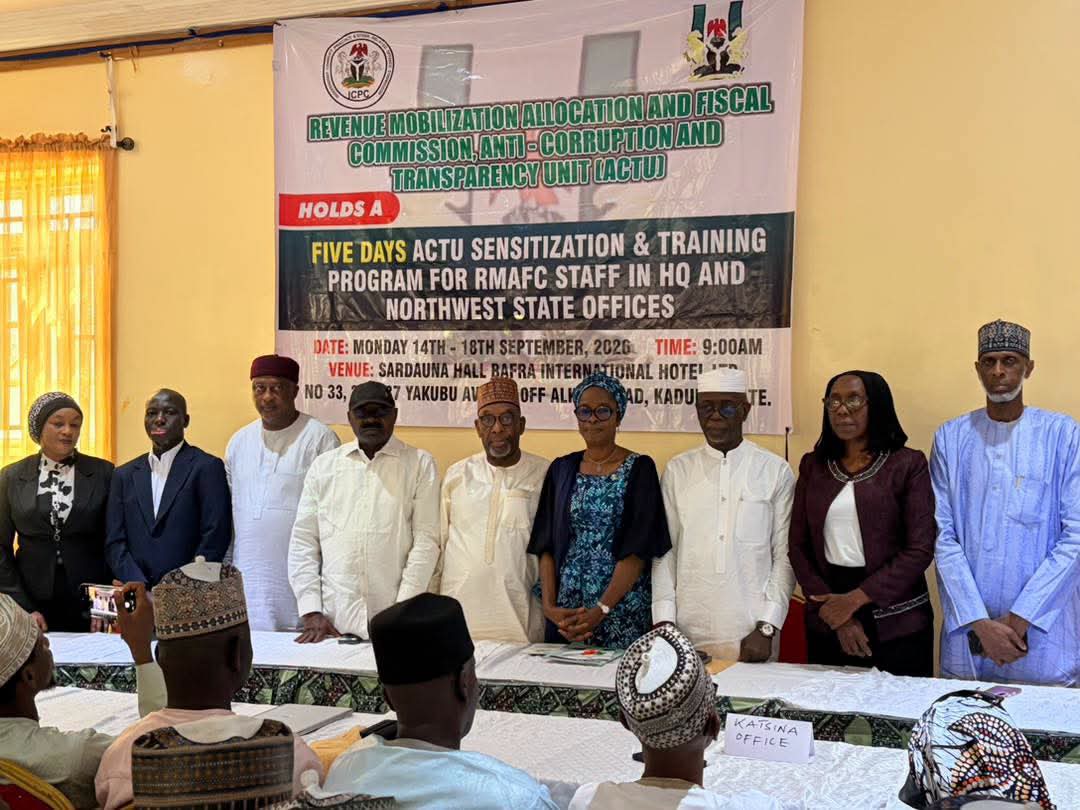
Chairman of the Commission, Dr Mohammed Bello Shehu, stated this at the opening of a five-day sensitisation and capacity-building workshop organised by the Commission’s Anti-Corruption and Transparency Unit (ACTU) for newly recruited officers serving at its headquarters and state offices across the North-West geopolitical zone.
The workshop, which began on September 14 and will end on September 18, 2026, is being held at Bafra Hotel, Kaduna State, in collaboration with the Independent Corrupt Practices and Other Related Offences Commission (ICPC).
Represented by the Federal Commissioner representing Kwara State and Provost of ACTU, Ismail Muhammed Agaka, the RMAFC chairman said the programme formed part of the Commission’s broader efforts to promote a culture of integrity, compliance, transparency, accountability and due process in public service.
Shehu said the constitutional responsibilities entrusted to RMAFC placed the Commission at the centre of Nigeria’s fiscal governance, requiring its officers to demonstrate not only competence and diligence but an uncompromising commitment to integrity.
According to him, public trust can only be earned when public officers discharge their responsibilities honestly, transparently and in the overall interest of the nation.
He stressed that the fight against corruption should not be left to ACTU or ICPC alone, but must be regarded as a collective responsibility of every public officer entrusted with government resources and responsibilities.
“Every decision we take, every public resource we handle and every official process we undertake must withstand the tests of legality, accountability, fairness and transparency.”
The chairman noted that corruption could manifest beyond bribery and diversion of public funds to include abuse of office, conflict of interest, favouritism, manipulation of official processes and deliberate disregard for established rules and procedures.
He therefore charged the participants to develop a culture in which integrity was demonstrated through their daily conduct, professional decisions and interactions with members of the public.
“As officers of the Commission, we must be above reproach. Let integrity guide our decisions, accountability define our actions, and service to the Nation remain our overriding commitment,” he said.
Shehu urged the participants to take full advantage of the training by engaging actively with resource persons and translating the knowledge gained into improved professional conduct and service delivery.
He also encouraged them to demonstrate humility, mutual respect and professionalism in their dealings with colleagues and members of the public, describing the workshop as an important foundation for their careers in the public service.
In his welcome address, the Chairman of ACTU, Dr Idris Musa, also emphasised the need for public servants to regard the fight against corruption as a collective responsibility.
Musa urged the participants to ensure that their decisions and actions were consistently guided by integrity and accountability, warning against practices capable of undermining public confidence in government institutions.
He specifically cautioned against abuse of office, conflict of interest, favouritism, manipulation of official processes and disregard for established rules and procedures.
The ACTU chairman further called on the officers to uphold transparency and accountability in the management of public resources and the execution of official responsibilities, stressing that their conduct must continually justify the confidence reposed in them by Nigerians.
Also speaking, the ICPC representative, Dr Anike Adeshina, Assistant Director, Public Education, said the sensitisation programme was part of the Federal Government’s broader anti-corruption campaign aimed at inculcating ethical and responsible public service values in newly recruited officers.
Adeshina said the workshop was designed to strengthen participants’ understanding of the need to conduct government business in accordance with relevant laws, regulations, procedures and ethical standards.
She urged the officers to promote and protect integrity within their workplaces while rejecting practices that violate the ethics of the public service, and commended RMAFC for organising the programme.
Some participants expressed optimism that the training would enhance their ethical conduct and improve service delivery within the Commission.
Aminu Sani, an accountant at the RMAFC Zamfara State office, said the programme would provide him with additional knowledge and experience to effectively discharge his responsibilities.
Similarly, Aminu Ibrahim Imam, a manager and chartered accountant in the Audit Department, identified accountability, transparency and integrity as key values expected to guide participants after the training.
He noted that the principles were particularly important to RMAFC given the Commission’s critical role in the management and allocation of the nation’s revenue.