

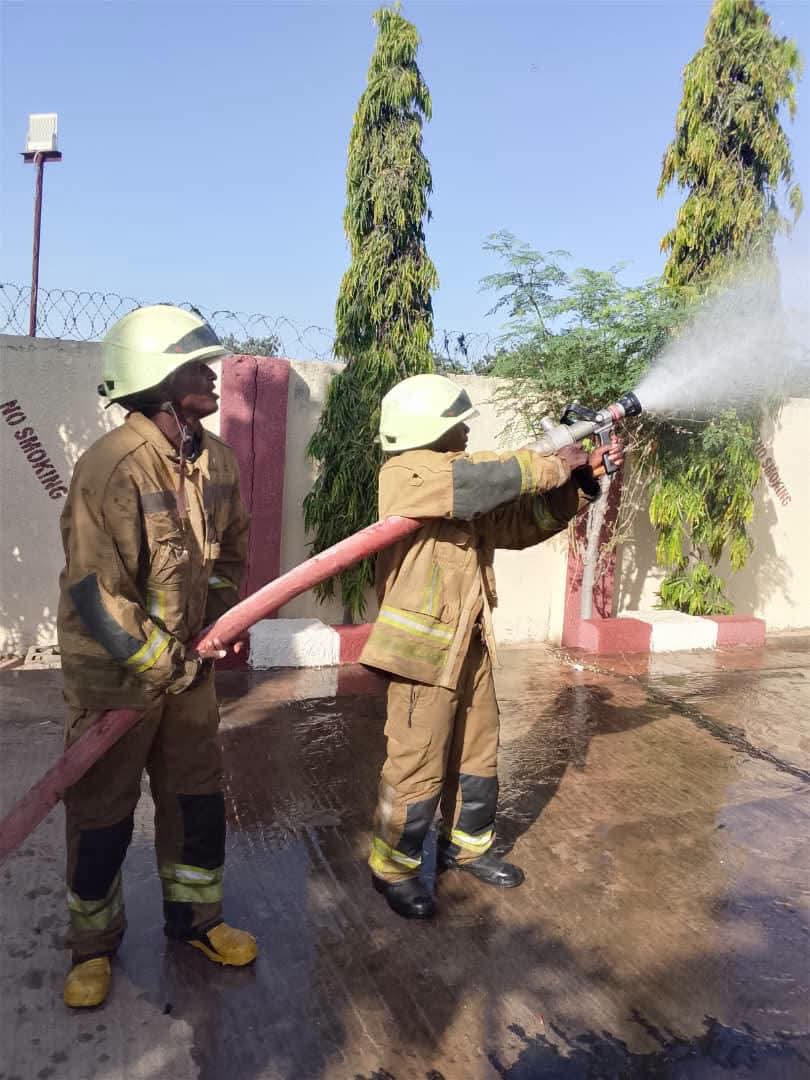
A safety practices in gas handling facilities, following an incident that could have resulted in massive destruction but for the swift intervention of the Federal Fire Service (FFS).
The fire, which involved a gas tanker during a Liquefied Petroleum Gas (LPG) transfer operation on Wednesday, November 11, 2026, was successfully contained by firefighters, preventing what could have been a major disaster in the area.
Although property estimated at ₦3 million was destroyed, the timely intervention of the Federal Fire Service saved additional property valued at approximately ₦40 million. Fortunately, no life was lost and no casualty was recorded.
According to a statement issued by the FFS Gombe State Command through its Public Relations Officer, MB Muazu, the incident occurred while the gas plant was transferring LPG from a tanker into its storage tank.
During the operation, escaping gas particles reportedly travelled through the air and ignited, triggering a fire that affected the generator room and a nearby mini-transformer.
The emergency response began at approximately 8:07 a.m. when the Command received a distress call.
Without delay, the Service deployed its FFS 215 Multipurpose Water Tender from the ATM Fire Station to the scene.
The firefighting team, led by DSF Ime Solomon, with FA Ibrahim Talese as the driver, arrived at 8:16 a.m., barely nine minutes after the distress call was received.
The team immediately commenced firefighting operations and successfully extinguished the flames using a medium water jet.
A thorough inspection of the affected facility was subsequently conducted to ensure that no residual fire or immediate threat remained.
A Narrow Escape and a Costly Warning
While the successful operation has been described as a major intervention in protecting lives and property, the incident highlights the dangers associated with LPG transfer operations, particularly when safety precautions are not strictly observed.
Gas leaks and accidental ignition can quickly turn routine operations into life-threatening emergencies, especially in facilities where generators, electrical installations and other potential ignition sources are located close to gas handling areas.
Reacting to the incident, the State Controller of the Federal Fire Service, Gombe State Command, Suleiman Mohammed Suleiman, called on gas plant operators to prioritise safety and strictly comply with established procedures during LPG handling and transfer.
He specifically warned operators against allowing generators and electrical equipment to operate close to gas transfer points.
He also stressed the importance of proper earthing and bonding systems, adequate ventilation, regular inspection of equipment and strict compliance with operational safety standards.
Beyond Emergency Response
The Gombe incident underscores the importance of preventive fire safety measures in gas plants and other facilities dealing with highly flammable substances.
While the Federal Fire Service’s rapid response helped prevent a potentially catastrophic outcome, the circumstances surrounding the outbreak serve as a reminder that effective fire prevention must begin before emergencies occur.
Gas plant operators, regulatory authorities and other stakeholders must therefore ensure that safety procedures are not treated as mere formalities but as essential requirements for protecting workers, customers, neighbouring communities and valuable infrastructure.
The Federal Fire Service reiterated its commitment to safeguarding lives and property, urging business operators and members of the public to take fire prevention seriously.
Residents were also advised to promptly report fire emergencies to the Gombe State Command through its dedicated emergency telephone line: 07031497455.
Ultimately, while the firefighters deserve commendation for preventing a larger tragedy, the incident leaves an important message: in gas handling operations, a small safety failure can have devastating consequences.