

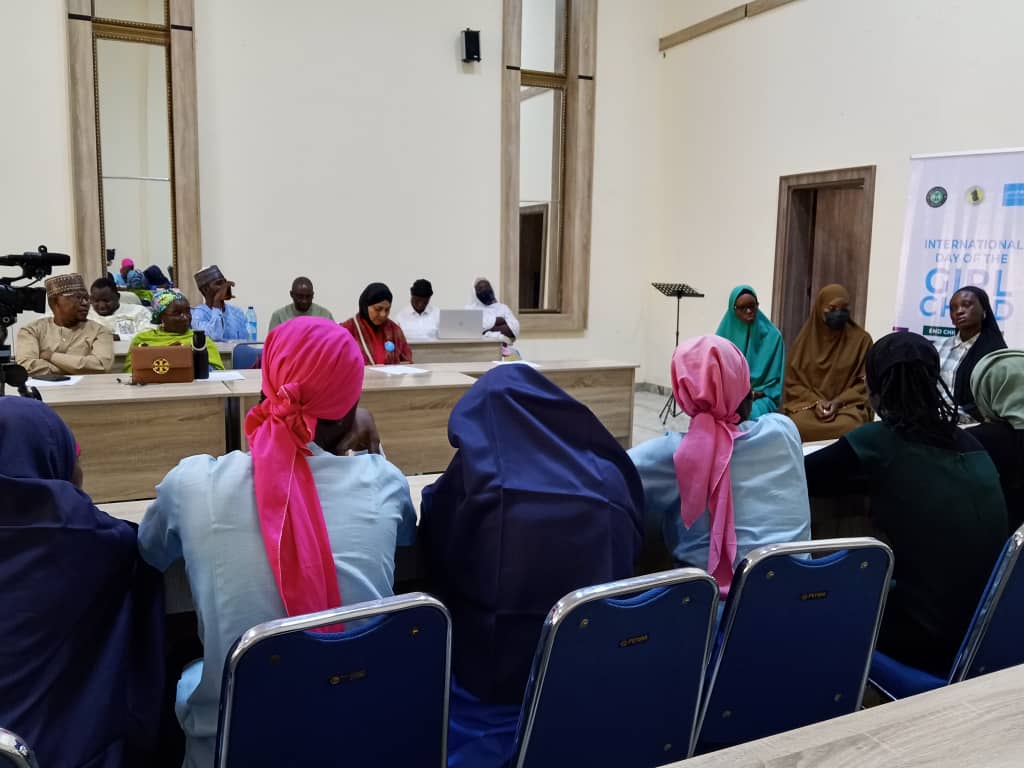
The United Nations Children’s Fund (UNICEF) has called for urgent and concerted action to end child marriage and increase investment in girls’ education, health, protection and empowerment.
Chief of UNICEF Bauchi Field Office, Dr Nuzhat Rafique, made the call during a one-day engagement in Gombe to mark the 2026 International Day of the Girl Child, observed annually on October 11.
The 2026 theme, “End Child Marriage and Invest in Girls’ Rights,” calls for stronger action to protect girls from harmful practices and ensure they have the opportunity to learn, grow, make informed choices and fulfil their potential.
Dr Rafique said child marriage remains a major obstacle to girls’ development, particularly in Bauchi and Gombe states, stressing that denying girls the opportunity to reach their full potential ultimately affects the development of society.
“If child marriage will not end, the girls will not get the right opportunities to grow to their best potential. And if girls are behind, then the nation will be behind,” she said.
According to UNICEF’s 2026 estimates, one in five girls globally is married before the age of 18, representing approximately 650 million women and girls alive today who were married during childhood.
UNICEF also reports that more than 12 million girls are married before reaching adulthood every year, with sub-Saharan Africa recording the highest prevalence at 31 per cent.
The organisation stressed that child marriage is one of the most widespread violations of girls’ rights, often denying girls the opportunity to remain in school, protect their health, live free from violence and realise their potential.
However, UNICEF noted that progress is possible. Investments in girls’ education, legal reforms and social protection have helped avert an estimated 68 million child marriages over the past 25 years.
The organisation identified keeping girls in school, expanding access to health, protection and social services, working with families and communities to challenge harmful social norms, and investing in girls’ rights and leadership as key solutions.
Dr Rafique therefore called for a coordinated response involving government, traditional and religious leaders, parents, communities, civil society organisations and other stakeholders.
She emphasised that girls’ rights must be protected across sectors, including education, health, nutrition and social protection.
UNICEF further noted that girls aged 15 to 19 are twice as likely as boys to be out of education, employment or training, while crises, conflict and displacement continue to increase girls’ vulnerability to child marriage, sexual violence and maternal mortality.
The organisation stressed that education remains one of the most powerful investments in girls, as keeping girls in school can delay marriage, expand their opportunities and equip them with the knowledge and skills to contribute to their families and communities.
The engagement also provided an opportunity for girls who had benefited from UNICEF’s life-skills programme to share their experiences and reflect on how the intervention had influenced their lives.
The girls testified that the programme had helped improve their knowledge, confidence and perspectives, enabling them to think differently about their future, understand their rights and make more informed decisions.
Through their testimonies, the girls highlighted the importance of providing safe spaces where they can learn, develop life skills, express themselves and participate in decisions affecting their lives.
They also called for greater involvement of traditional rulers, religious leaders and women leaders in efforts to protect girls and end child marriage.
According to the girls, influential community leaders have an important role to play in challenging harmful social norms, encouraging parents to keep girls in school and creating supportive environments where girls can grow and realise their potential.
Also speaking, the representative of the Gombe State Ministry for Local Government and Community Development, Abdulrazaq Abdulmumi, said the fight against child marriage must extend to the grassroots.
Abdulmumi described child marriage as not only a girls’ issue but also a development, health, education and community issue, noting that Local Governments are strategically positioned to influence change at community level.
“As a Ministry in charge of Local Governments and Community Development, we are closest to the grassroots,” he said.
He stressed that ending child marriage could not be achieved solely through actions at the state capital, but must be addressed in wards, villages, traditional institutions and communities.
“Ending child marriage cannot be achieved in Government House alone. It must be won in the wards, in the villages, in the palaces of our Emirs and District Heads.”
The ministry pledged to take the communique from the engagement to the chairmen of the 11 Local Government Areas under the Association of Local Governments of Nigeria (ALGON), with a commitment to make ending child marriage an important component of community development at LGA level.
He also called on parents and community leaders to prioritise girls’ education and protection.
“Your education is more valuable than any bride price. You have a right to be a child, to go to school, to be healthy, and to choose your future.”
The engagement called for sustained community engagement, positive parenting and stronger collaboration among government, traditional and religious institutions, parents, women leaders and civil society organisations to challenge harmful social norms.
Participants stressed that every girl deserves the opportunity to stay in school, remain safe, exercise her rights and shape her own future.