

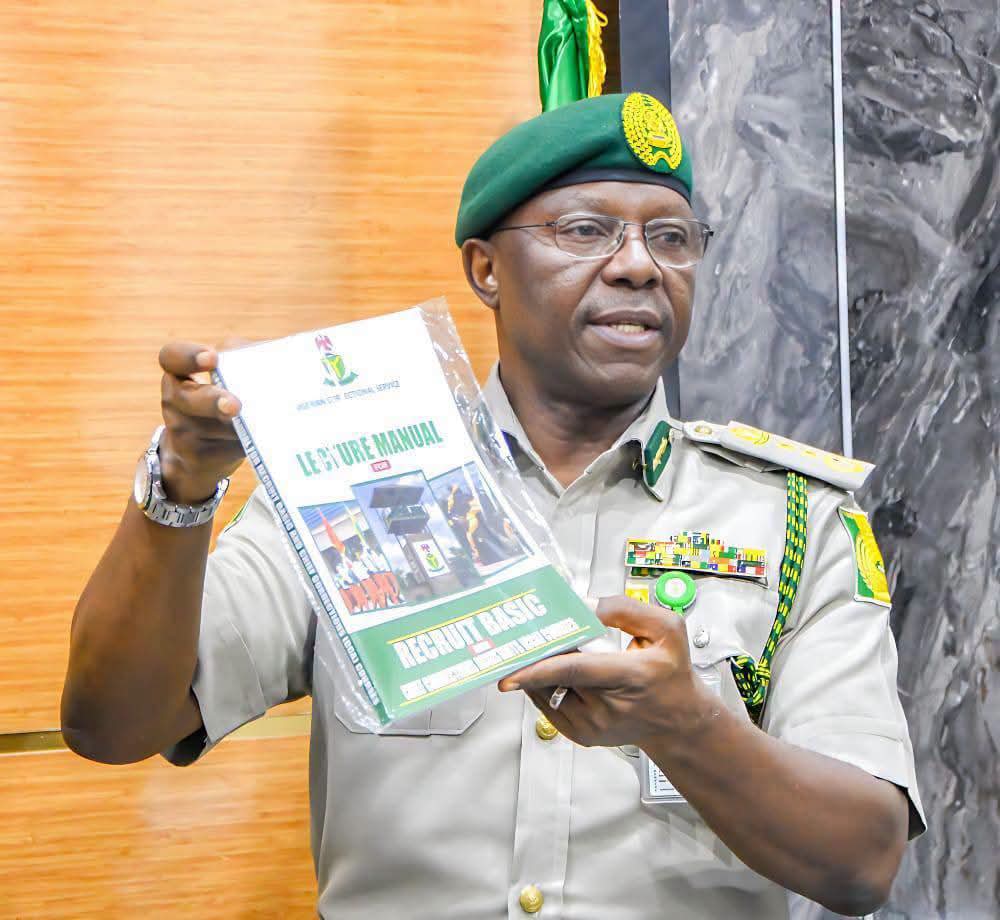
The Nigerian Correctional Service (NCoS) has unveiled its first-ever Unified Training Manual and standardised professional Course Badges as part of efforts to strengthen professionalism and ensure uniformity in personnel training across the Service.
The initiative introduces a single Service-wide training doctrine for all NCoS training institutions and replaces the 2019 Training Manual.
The revised manual, according to the Service, has been comprehensively updated to reflect contemporary realities, evolving correctional practices and emerging professional demands.
It provides a common framework for training across various cadres, disciplines and specialised areas, with the aim of ensuring consistency in the delivery of instructions nationwide.
A major feature of the new manual is that it was developed internally by personnel of the Service, unlike the previous practice in which significant portions of training materials were produced by external bodies.
The NCoS said the internally developed curriculum would deepen institutional ownership, preserve professional knowledge within the Service and ensure that training content remains relevant to operational realities.
The revised framework covers routine and specialised courses, including Command Courses, Commissioned Officers Courses, Basic Recruit and Chief Corrections Assistants Courses, as well as specialised and refresher courses.
The Service also unveiled unified course badges for different cadres, including the Advanced Command Course Badge for Controllers of Corrections, Command Course Badge for Deputy Controllers of Corrections, Chief Superintendent of Corrections Course Badge and Assistant Superintendent of Corrections Course Badge.
Speaking at the unveiling ceremony, the Controller-General of Corrections, Sylvester Ndidi Nwakuche, MFR, mni, pcc, commended members of the Manual Review Committee and other personnel who contributed to the development of the training manual and course badges.
Nwakuche described the initiative as a landmark achievement that would strengthen professionalism, institutional identity and uniformity in personnel training.
The Controller-General, who was decorated with one of the newly unveiled badges, described the decoration as a symbol of professional identity and accomplishment, urging officers to uphold the discipline, values and professional excellence associated with the badges.
He also decorated Deputy Controllers-General with the Advanced Command Course Badge in recognition of their professional advancement.
The Deputy Controller-General in charge of Training and Staff Development, DCG Olanrewaju Amoran, said the unified manual was developed to provide a contemporary training resource capable of addressing the changing demands of correctional administration and practice.
Amoran said experienced personnel from relevant professional areas contributed to the development process, ensuring that the manual reflected institutional experience, operational realities and emerging trends in corrections.
He added that the manual would serve as a common reference for instructors and trainees, promote consistency in course delivery and improve the quality of professional training across NCoS institutions.
The DCG further said the initiative would support continuous professional development by providing standardised learning materials for officers throughout their career progression and promote a culture of competence and lifelong learning.
Earlier, the Chairman of the Manual Review Committee and Deputy Controller-General in charge of the Human Resources Directorate, DCG Ado Sale, said the unified manual and course badges would contribute significantly to the professional development of officers.
He stressed that the badges were professional distinctions earned through prescribed training and formally conferred by Commandants of NCoS training institutions, rather than ceremonial accessories available for purchase.
The ceremony also featured the presentation of an Award of Excellence to the Controller-General by the Review Committee in recognition of his leadership and support for the initiative.
Nwakuche subsequently presented plaques and certificates of recognition to members of the committee for their contributions to the development of the new curriculum and training manuals.
The NCoS said the initiative forms part of ongoing reforms aimed at strengthening institutional capacity, promoting training excellence and building a modern correctional workforce capable of responding to emerging challenges.
The Service reaffirmed its commitment to continuous professional development and to building a competent, disciplined and forward-looking workforce to support its mandate of securing custodial centres and facilitating the reformation, rehabilitation and reintegration of offenders into society.